The post Improving Customer Convenience With 24/7 Click-and-Collect Lockers appeared first on Smiota.
]]>The Changing Expectations of Modern Shoppers
Today’s consumers value speed and independence more than ever. Whether buying groceries, electronics, or fashion items, they want their orders ready for pickup exactly when it suits them – not when a store’s staff or schedule allows. Traditional BOPIS counters often fall short of these expectations. Customers must wait in lines, locate staff members, or navigate busy store environments to retrieve their orders. These inconveniences directly impact consumer satisfaction and can discourage repeat purchases.
Click-and-collect lockers offer an entirely different experience. Once an order is prepared, store staff simply place it inside a secure locker compartment. The system automatically notifies the customer that their order is ready, along with a unique access code or QR link. The customer can then walk up to the locker at any time – even outside store hours – scan the code, and collect their order within seconds. This level of autonomy transforms the pickup process from a point of frustration into a moment of ease and efficiency.
How Smart Lockers Enhance Retail Efficiency
Beyond customer convenience, smart lockers significantly improve operational efficiency for retailers. Traditional order pickup processes require staff involvement at multiple points – order confirmation, storage, pickup verification, and handover. During busy periods, this workflow becomes chaotic and slows down both store staff and customers.
Smart lockers eliminate this bottleneck. Employees load completed orders into lockers at their convenience, which frees them from the pressure of immediate handovers. This shift allows retail teams to focus on core responsibilities like helping customers on the floor, managing inventory, and maintaining store experience. Additionally, the automation of order collection reduces human error, minimizes misplaced orders, and ensures that customers always retrieve the correct item.
Retailers that use smart lockers also notice improved throughput. Since customers can pick up orders without interacting with store staff, more orders can be fulfilled and distributed in less time. This becomes particularly valuable during holiday seasons, major sales, and weekends when order volume spikes and floor staff are stretched thin.
Creating a Safe and Contactless Pickup Experience
In a post-pandemic world, safety and minimal physical contact remain important considerations for many shoppers. While traditional BOPIS counters require staff interaction, click-and-collect lockers deliver a fully contactless experience. Customers access their orders without speaking to anyone, standing in crowded areas, or handling items passed through multiple hands.
Smart lockers further enhance safety by providing individual, sanitized compartments that keep orders protected until pickup. Some lockers also support mobile-based unlocking, where customers can open the locker directly from their smartphone without touching the screen or keypad. For retailers looking to maintain high safety standards while delivering convenience, lockers create an ideal balance between hygiene, independence, and speed.
Boosting Customer Loyalty Through Better Experiences
A smooth and efficient pickup experience has a direct impact on customer satisfaction and loyalty. When shoppers trust that their orders will be ready, accurate, and easy to collect, they are more likely to purchase again. Retailers who implement lockers often see improvements in repeat sales, positive reviews, and overall brand trust.
Lockers also help retailers stand out in a crowded market. As more stores compete for customer attention, offering fast and flexible pickup options becomes a valuable differentiator. Smiota’s advanced click-and-collect systems help retailers provide world-class service that goes beyond traditional convenience – creating memorable customer experiences that drive engagement and long-term loyalty.
Conclusion
Click-and-collect lockers represent the next evolution of retail fulfillment. They empower customers with flexibility, accelerate order pickup, and reduce pressure on retail staff. As consumer expectations continue to grow, retailers must embrace solutions that offer both convenience and operational efficiency. With their ability to operate 24/7, integrate seamlessly into store workflows, and deliver consistent satisfaction, smart lockers are becoming an essential component of modern omnichannel retail strategies. Smiota’s intelligent locker systems ensure that every pickup is fast, secure, and effortless -setting a new standard for retail convenience.
FAQs
- Are click-and-collect lockers suitable for small and medium retailers?
Yes. Smart lockers can be deployed in stores of all sizes and configured to match order volume, physical space, and customer traffic.
- Can lockers handle perishable or temperature-sensitive items?
Absolutely. Smiota offers heated and refrigerated locker options that allow retailers to safely store fresh food, meal kits, and temperature-controlled products.
- Does using lockers speed up the customer pickup process?
Yes. Most customers complete their order pickup in less than ten seconds, significantly reducing wait times and congestion.
- Do lockers reduce the workload on store staff?
Yes. Lockers automate the order handover process, allowing employees to focus on more important tasks like customer engagement and store management.
The post Improving Customer Convenience With 24/7 Click-and-Collect Lockers appeared first on Smiota.
]]>The post How Smart Lockers Are Redefining Retail Returns Management appeared first on Smiota.
]]>Smart lockers, a growing innovation in the last-mile delivery and returns space, are proving to be a transformative solution for retailers. By bridging the gap between convenience, efficiency, and automation, smart lockers – like those offered by Smiota – are redefining how retailers approach reverse logistics in the modern marketplace.
The Persistent Challenges in Retail Returns Management
Returns are no longer an occasional nuisance – they are part of the standard consumer journey, especially in e-commerce. Yet many retailers still manage returns using outdated, labor-heavy processes that strain both staff and budgets.
Common pain points include:
- In-store congestion during peak hours, especially around customer service counters
- Delayed return processing, causing lag in refund cycles and restocking
- High labor costs tied to manually handling return authorization, repackaging, and routing
- Customer dissatisfaction from unclear or inflexible return policies
- Inventory distortion due to return lags and misplacement
On the logistics side, return shipments cost retailers an average of $10 to $20 per item, especially when accounting for shipping, labor, and resale markdowns. For omnichannel retailers, the challenge is even greater – juggling returns across multiple platforms, warehouses, and stores while preserving a consistent customer experience.
Understanding Smart Lockers and Their Retail Applications
Smart lockers are secure, electronically controlled storage compartments designed to facilitate unattended package deliveries and returns. In a retail context, they serve as automated return stations that allow customers to drop off items quickly – often without needing assistance from staff.
At Smiota, we specialize in delivering smart locker systems tailored for retail environments. These lockers are:
- Accessible 24/7 (depending on location)
- Equipped with real-time tracking and automated notifications
- Integrated with return management systems (POS, CRM, ERP)
- Secure and tamper-resistant
- Customizable in size, style, and branding
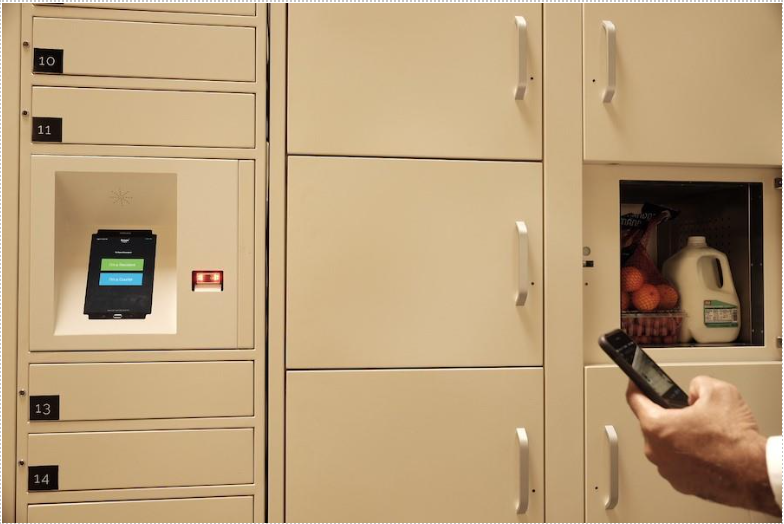
They can be deployed in various settings, including store entrances, shopping centers, apartment complexes, office buildings, transit hubs, and universities.
Why Smart Lockers Are Changing the Game in Returns Management
Beyond doubt, smart lockers are making the process of retail returns management faster and more efficient for both store owners and customers. Here, let us have a detailed look at the different reasons why this is a game-changer.
1. Operational Efficiency
Smart lockers simplify the returns workflow. When customers initiate a return online or in-app, they receive a unique drop-off code or QR code. They visit a locker location, scan their code, and deposit the item – no lines, no forms, no waiting.
For the retailer, this means:
- Fewer return transactions at the counter
- Faster returns intake and dispatch
- Less dependence on store labor for handling logistics
- Improved scalability during seasonal peaks or promotional campaigns
Lockers consolidate return volumes, which can then be picked up and shipped back to distribution centers in bulk, rather than piecemeal.
2. Significant Cost Reductions
Smart lockers reduce the hidden costs of returns. They minimize:
- Time spent by staff manually checking, verifying, and repackaging items
- Materials wasted on excess packaging for mailed returns
- Transportation costs via consolidated pickups
- Space requirements for in-store return storage
By automating key parts of the return process, retailers see long-term savings in staffing, facilities, and logistics – while improving consistency and reducing error rates.
3. Seamless Customer Experience
Today’s consumers are busy and digitally savvy. They expect brands to deliver simplicity, speed, and self-service options – especially after a purchase.
Smart lockers support this by offering:
- Instant, no-contact drop-offs
- Flexible hours and locations
- Clear, step-by-step instructions via app or email
- Faster return confirmation and refund triggers
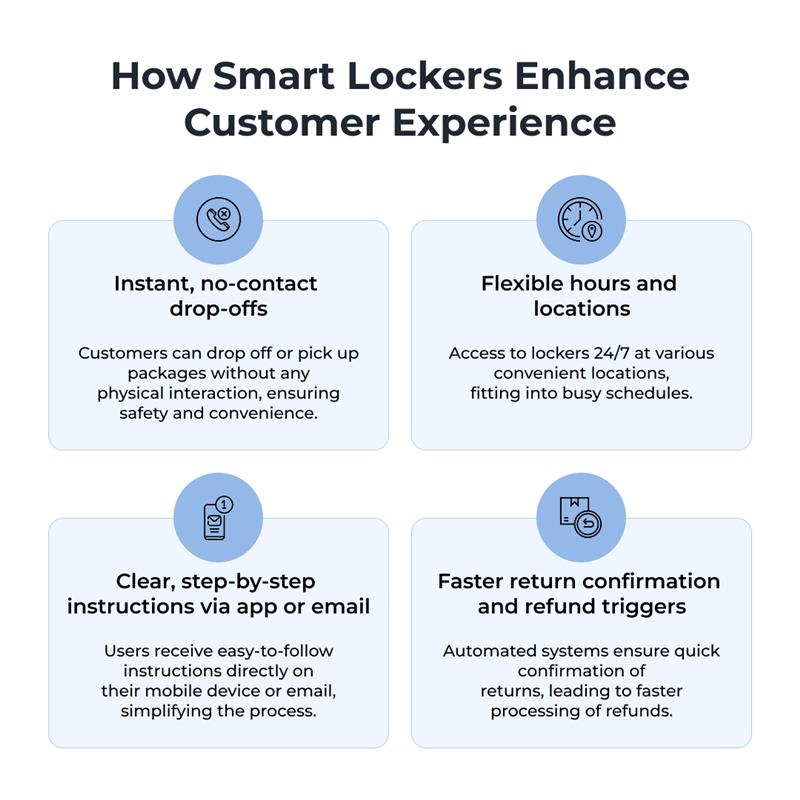
When customers feel that returning an item is effortless, they are more likely to shop with that retailer again – even if their original purchase didn’t work out. This builds trust and long-term loyalty.
4. Actionable Data and Insights
Unlike traditional return methods, smart lockers generate real-time data on each transaction. Retailers using Smiota lockers can track:
- Return volumes by location or timeframe
- Most returned SKUs
- Return reasons (when collected via app)
- Locker usage and capacity trends
- Repeat return behavior among customers
This information helps retailers optimize inventory management, improve product quality, and refine return policies – all while improving forecasting and fraud prevention.
What to Consider When Implementing Smart Lockers
Retailers ready to integrate lockers into their returns strategy should consider the following:
- Placement and access: Choose locations that align with customer convenience – e.g., store entrances, public hubs, or residential lobbies.
- System integration: Ensure locker software connects smoothly with existing platforms for inventory, CRM, and refund processing.
- Locker capacity and configuration: Select locker sizes and module layouts based on product types and return volumes.
- Branding and communication: Use locker signage and digital messaging to promote the return option and guide users clearly.
- Training and operations: Train store teams on locker maintenance, return collection schedules, and customer troubleshooting.
Smiota’s team offers hands-on support during the planning and deployment phases, ensuring lockers are configured to match the retailer’s goals and workflows.
The Road Ahead: Smart Lockers and the Future of Returns
As customer expectations continue to rise, and as sustainability becomes a core business priority, smart lockers will play an increasingly central role in retail ecosystems.
In the near future, we’ll see:
- AI-driven return routing to reduce waste and accelerate restocking
- Locker-enabled exchanges and product upgrades
- Integration with recommerce and circular economy platforms
- Shared locker networks that span multiple retailers in urban centers
Returns are no longer a back-end task – they’re a brand experience. With smart lockers, retailers can control that experience with the same level of care they apply to the initial sale.
Conclusion
Smart lockers are redefining retail returns management by turning one of the most painful parts of the retail cycle into a point of pride. They give businesses a way to streamline operations, lower costs, and meet customers where they are – on their terms.
At Smiota, we’re proud to be helping retailers evolve their returns strategy with innovative, scalable, and customer-first locker solutions. As the retail landscape continues to shift, one thing is clear: the future of returns is smart, secure, and streamlined – and lockers are leading the way.
To discover how Smiota’s smart locker solutions can enhance your returns process, please get in touch with us here.
The post How Smart Lockers Are Redefining Retail Returns Management appeared first on Smiota.
]]>The post Revolutionize Holiday Returns with AI-Optimized Smart Locker Systems appeared first on Smiota.
]]>According to recent studies, nearly 17% of all holiday merchandise sales result in returns, creating a significant strain on supply chains and customer service systems. The rise of eCommerce has further complicated the issue, with reverse logistics costs escalating and customer expectations growing more demanding by the day.
Unfortunately, many retailers still rely on outdated return processes that are inconvenient, time-consuming, and frustrating. Long queues, complex shipping instructions, and inconsistent policies lead to a poor post-purchase experience, damaging brand perception and eroding customer loyalty.
As consumers become more digitally savvy and time-conscious, the demand for fast, contactless, and self-directed return solutions is growing. This is where AI-optimized smart locker systems come in, offering a seamless, scalable, and customer-friendly way to handle holiday returns.
The Problem with Traditional Returns
Despite advances in retail technology, traditional return systems remain deeply flawed. They are inconvenient for customers, resource-intensive for retailers, and environmentally unfriendly. Let’s take a closer look at the key challenges:
Long In-Store Lines Frustrate Customers
After the holidays, shoppers flood stores not only to grab year-end deals but also to return items. This creates long queues that waste time and test patience. Shoppers who received gifts they don’t need or want to spend their time waiting in line, only to face a tedious return process at the counter.
Store-Hour Dependency Restricts Flexibility
Most traditional returns require customers to visit the store during operating hours. This doesn’t align well with modern lifestyles. Working professionals, caregivers, and students often struggle to find the time, leading to delays or even missed return windows.
Manual Handling Overloads Staff
In-store staff are usually not trained or equipped to handle the sheer volume of holiday returns efficiently. This leads to mistakes, longer processing times, and unhappy customers. Additionally, it prevents staff from focusing on other revenue-generating tasks.
Environmental Impact Increases
Returning items by mail adds another layer of complexity. Products often need to be repackaged, labeled, and shipped long distances. This increases the carbon footprint and results in more packaging waste, all of which contradicts modern sustainability goals.
In short, traditional returns are a bottleneck in the retail experience. Retailers need a solution that’s faster, smarter, and more efficient across all fronts.
Smart Lockers: The Future of Returns, Today
Smart lockers are redefining how returns work in the modern retail environment. These AI-optimized systems function as secure, 24/7 self-service kiosks where customers can drop off returns at their convenience. The process is simple, fast, and user-friendly, making it an ideal solution for handling high return volumes, especially during the post-holiday period.
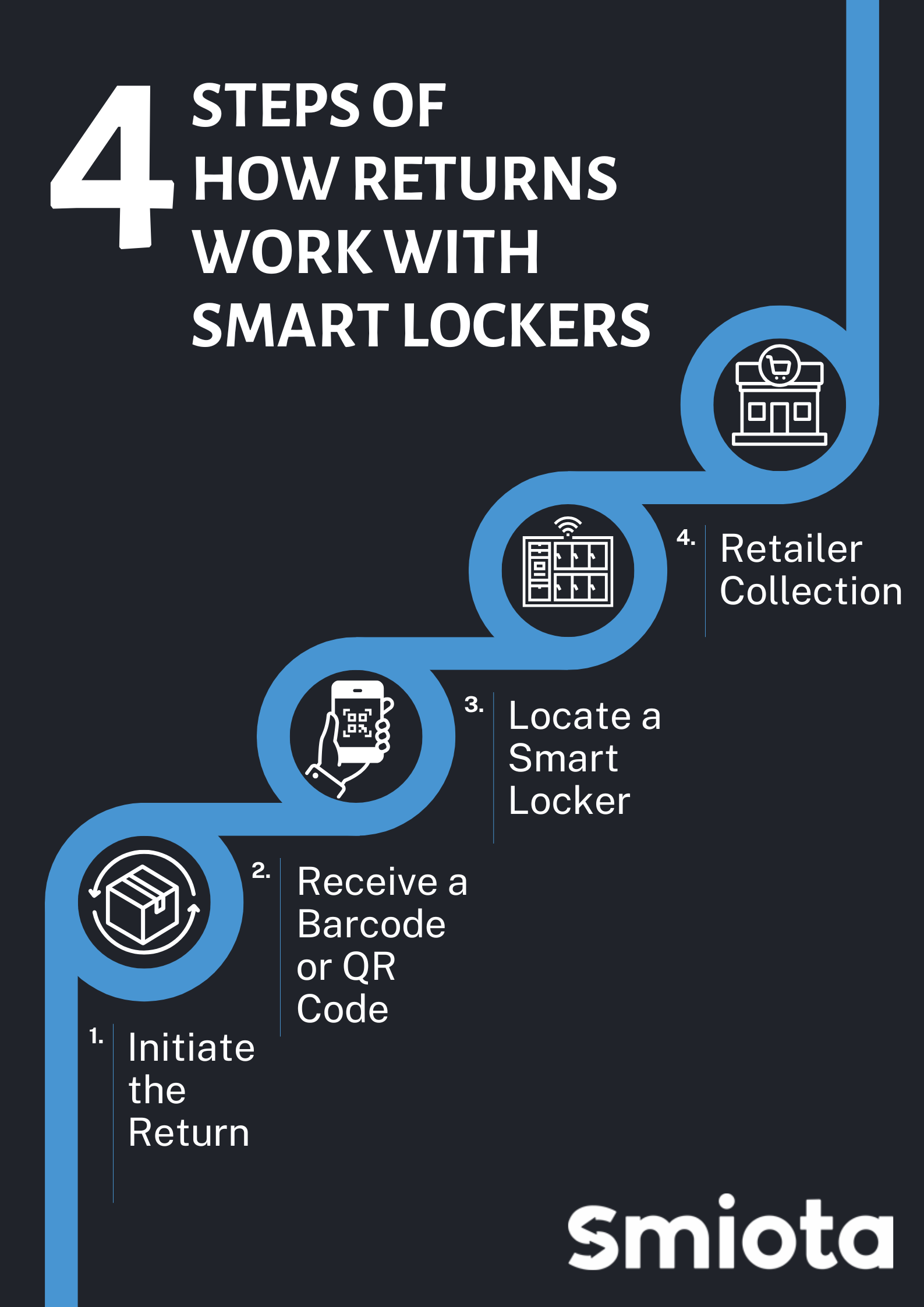
How It Works:
- Customer Initiates Return Online: The return process begins on the retailer’s website or app.
- Secure Code is Generated: A unique QR code or barcode is issued.
- Nearest Smart Locker Located: Customers choose a nearby smart locker for drop-off.
- Item Deposited: Scanning the code opens a locker compartment.
- Retailer Retrieves and Processes: The item is collected in bulk by logistics staff and quickly sorted.
Why This Model Works
This self-service approach eliminates the need for in-store interactions, reduces operational pressure, and offers unmatched convenience. For retailers, it’s a win-win: less staff workload, faster returns processing, and increased customer satisfaction.
As more consumers become accustomed to services that prioritize autonomy and speed, smart lockers are quickly becoming a must-have for forward-thinking retailers.
Key Benefits of Smart Locker Returns
The adoption of smart locker technology can revolutionize retail return logistics. Here are the core benefits:
24/7 Accessibility
Customers can return items anytime, not just during store hours. This flexibility aligns with the modern demand for convenience, allowing shoppers to complete returns at a time that suits their schedule.
Faster Processing
Returns are collected in bulk, sorted with the help of AI, and processed swiftly. This minimizes delays in refunds and restocking, accelerating the resale cycle and reducing holding costs for retailers.
Cost Efficiency
Automating the return process via smart lockers cuts down on in-store labor and reverse logistics costs. Retailers can redeploy staff to more valuable roles while streamlining backend operations.
Lower Carbon Footprint
Consolidating returns at centralized locker locations reduces the need for individual shipping, leading to lower fuel consumption and fewer emissions. Plus, fewer packaging materials are used when customers drop off items in person.
Positive Brand Perception
Retailers who offer smart locker returns demonstrate a commitment to innovation, customer satisfaction, and sustainability. This can significantly enhance brand loyalty and attract eco-conscious consumers.
Altogether, these benefits position smart lockers as a smart investment with both immediate and long-term ROI.
Return Workflow with Smart Lockers
Understanding the return process in detail helps illustrate just how streamlined smart locker systems are:
Customer Initiates Return
On the retailer’s app or website, the customer selects the item to return and provides a reason. The system confirms eligibility and moves to the next step.
Receives Secure Code
A QR code or barcode is generated instantly and sent to the customer via email, SMS, or app notification.
Locates Smart Locker
Using integrated GPS tools or manual search, customers find the most convenient locker nearby. Availability is updated in real-time.
Deposits Item
At the locker, they scan the code. A compartment opens automatically. The customer places the item inside and closes the door.
Retailer Processes
Items are collected in bulk by the logistics team. Smart systems categorize and prioritize them for inspection and restocking, often within hours.
This efficient, tech-driven workflow ensures a smooth experience from start to finish, significantly reducing turnaround times.
Sustainability Matters
Beyond operational efficiency, smart lockers also support environmental sustainability. In a world increasingly focused on ESG (Environmental, Social, and Governance) initiatives, retailers can no longer afford to overlook the ecological impact of returns.
Reduces Packaging Waste
Smart lockers eliminate the need for return shipping boxes and extra materials. Since the return doesn’t travel through conventional mail, customers often use minimal or reusable packaging.
Cuts Transport Emissions
Traditional mail-in returns involve numerous shipping touchpoints, each adding to carbon emissions. Smart lockers enable bulk collection from centralized locations, reducing the need for long-distance transportation.
Aligns with ESG Goals
Offering sustainable return options helps retailers achieve their ESG objectives. It also appeals to environmentally conscious consumers, who are more likely to support brands that share their values.
Smart locker systems not only solve logistical challenges but also contribute positively to broader sustainability goals, making them an ethical and practical choice.
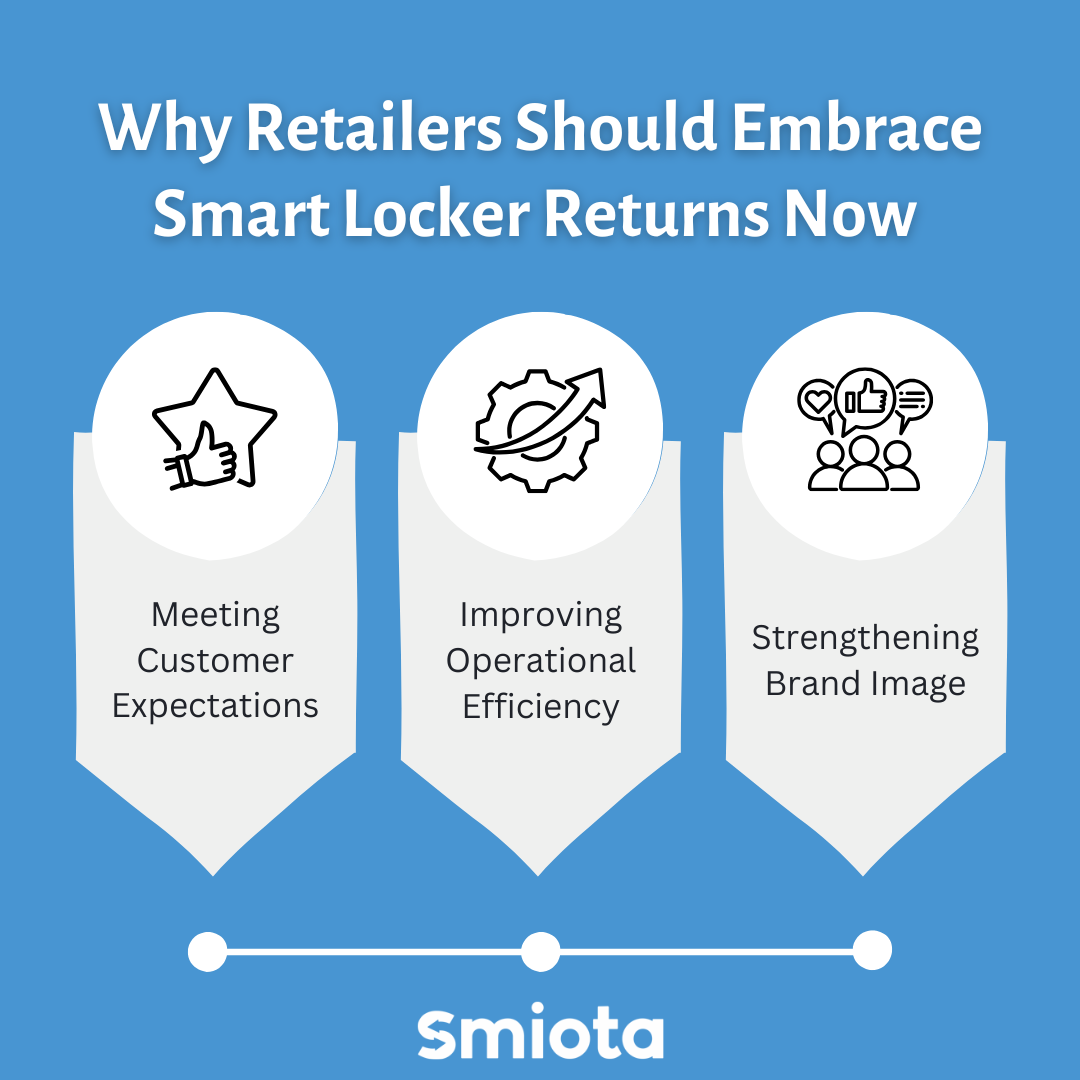
Why Smart Locker Returns Are a 2025 Retail Imperative
As we look ahead, smart lockers are not just a luxury but a necessity. Retailers who implement AI-powered return systems now will have a significant head start in the competitive landscape of 2025 and beyond.
Lead in Omnichannel Convenience
Smart lockers seamlessly bridge online and offline retail channels. They enable a truly omnichannel experience where returns are just as easy as purchases.
Drive Customer Loyalty and Retention
A smooth, hassle-free return experience builds trust. When customers know they can return items quickly and easily, they’re more likely to shop again.
Enhance Operational Agility
Retailers can respond faster to seasonal surges and unexpected spikes in returns. Automated systems also free up staff for more strategic tasks.
Become a Sustainability Leader
Incorporating smart locker returns strengthens a retailer’s green credentials. It’s a tangible step toward reducing waste and emissions while delighting eco-conscious consumers.
By investing in smart locker technology, retailers are not just solving today’s problems—they’re preparing for tomorrow’s expectations.
Conclusion: Smarter Returns for Smarter Retail
As holiday return volumes rise and customer expectations evolve, one thing is clear: traditional return systems no longer suffice. The future lies in AI-optimized smart locker technology that makes returns fast, frictionless, and environmentally responsible.
Smart lockers offer a comprehensive solution to some of the most pressing issues in modern retail—from operational inefficiency to environmental impact. By embracing this innovation, retailers can reduce return-related costs, improve customer satisfaction, and lead the charge toward a more sustainable retail future.
Those who act now won’t just keep up with consumer demands—they’ll set the standard for smarter, greener, and more efficient retail logistics in 2025 and beyond.
The post Revolutionize Holiday Returns with AI-Optimized Smart Locker Systems appeared first on Smiota.
]]>The post How Smart Lockers Help Distributors Thrive in the Omnichannel Era appeared first on Smiota.
]]>Once the unsung heroes of supply chains, distributors are now facing intense pressure to adapt or be edged out. In a landscape where manufacturers and D2C (direct-to-consumer) brands are rapidly taking control of their own fulfilment processes—building online stores, mobile apps, and integrated logistics systems—traditional distributors risk being sidelined.
What’s changed? Manufacturers no longer rely on intermediaries to manage their customer relationships. D2C brands have eliminated middlemen altogether, building robust last-mile networks that offer real-time tracking and doorstep delivery. Customers are enjoying seamless shopping experiences—from browsing to unboxing—all controlled by the brand.
To stay relevant in this new paradigm, distributors need more than just inventory and warehousing capabilities. They need to become digitally enabled service providers who can compete in an omnichannel world. That’s where smart locker technology comes in.
Smart lockers offer a bridge between digital convenience and physical efficiency, giving distributors the tools to plug into omnichannel strategies, reconnect with customers, and offer a level of service that matches modern expectations.
The Rise of Omnichannel Retail and the Distributors’ Dilemma
In today’s fast-moving commerce ecosystem, a few key shifts are reshaping how goods move from producer to consumer:
- Manufacturers are going direct: By setting up online storefronts and mobile apps, manufacturers are cutting out intermediaries and owning the customer experience end-to-end.
- D2C brands are on the rise: These nimble players leverage technology to optimize every step of the supply chain, bypassing distributors entirely and enhancing delivery efficiency.
- Customer expectations are sky-high: Modern buyers expect same-day shipping, flexible pickup options, real-time notifications, and hassle-free returns. The bar has been raised.
This evolution has left many distributors struggling to find their place.
Those who continue to operate strictly within the boundaries of warehouse logistics risk losing visibility and strategic relevance. Without direct consumer touchpoints, they’re seen as background players—not the value-adding partners they once were.
To reverse this trend, distributors need to reimagine their operations. They must start participating in customer-facing experiences, expanding their roles beyond backend fulfilment. Embracing smart locker technology is a compelling way to make this leap.
Omnichannel Explained: Why It Matters
Omnichannel commerce isn’t just a buzzword—it’s a fundamental shift in how customers interact with brands.
Rather than following a linear purchase path, consumers now engage with businesses through multiple, interconnected channels. A typical customer might:
- Order a product online,
- Pick it up from a locker at a retail outlet,
- Return it via a secure drop box near their office,
- And track every step via a mobile app.
Omnichannel is about offering choice, flexibility, and consistency—no matter where or how the customer interacts with the brand.
Distributors who want to compete must offer similar agility. That means integrating physical and digital logistics, enabling hybrid delivery and pickup models, and responding quickly to changing demands. Smart lockers act as enablers in this transition. By introducing customer-friendly pickup and return points into their distribution network, distributors can evolve from static warehouses to dynamic fulfilment partners.
What Are Smart Lockers?
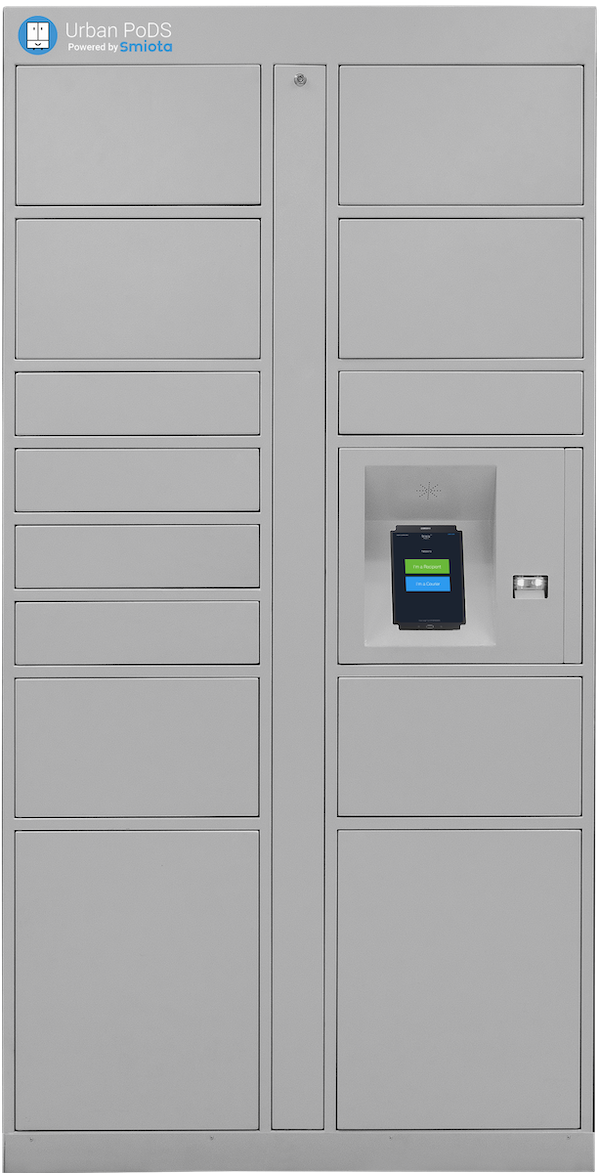
At their core, smart lockers are automated, secure storage systems designed to streamline modern fulfilment needs. They make it easy for customers to pick up online orders, return items without hassle, and for businesses to manage last-mile deliveries more efficiently.
Modern smart lockers feature:
- Mobile access and PIN-based authentication for seamless, contactless interactions,
- Real-time notifications for tracking and pickup status,
- Integrated security protocols like RFID tagging, encrypted logins, and biometric verification,
- Robust software integration with ERP, CRM, warehouse management systems (WMS), and transportation management systems (TMS).
For distributors, this technology opens a new world of operational flexibility. It provides a physical touchpoint that’s automated, secure, and scalable—without the overhead of setting up retail outlets or customer service counters.
Why Smart Lockers Are Ideal for Distributors in Omnichannel
For distributors navigating this complex terrain, meeting these expectations without inflating costs or overhauling operations can be a challenge. As a modern, adaptable solution, smart lockers help distributors bridge the gap between digital demand and physical delivery, making them an ideal fit for omnichannel fulfilment strategies.
- Convenience and 24/7 Accessibility
Today’s buyers value speed and flexibility above all else. With smart lockers, customers can:
- Pick up or return products on their schedule—no more racing to a store before closing hours,
- Skip long wait lines or uncertain delivery windows,
- Select locker locations based on convenience—be it near their home, gym, or workplace.
This 24/7 accessibility not only boosts customer satisfaction but also empowers distributors to expand their reach without expanding real estate.
- Faster Fulfilment, Fewer Errors
For distributors, smart lockers are more than just drop-off points—they are fulfillment accelerators. By consolidating deliveries into locker stations:
- Failed delivery attempts are virtually eliminated,
- Fuel costs and delivery times are reduced through centralized drop locations,
- Errors associated with manual handoffs or porch piracy are minimized,
- Orders move faster through the system, improving turnover and inventory accuracy.
This results in a smoother, more reliable last-mile process, which is critical for maintaining service-level agreements with partners and customers.
- Secure, Contactless Operations
In a post-pandemic world, contactless delivery and hygiene are essential. Smart lockers offer:
- Touch-free interactions using mobile devices or QR codes,
- Encrypted authentication to safeguard privacy,
- Monitored access to prevent unauthorized entry.
This reassures both B2B and B2C customers, especially in high-traffic or shared environments such as residential complexes, commercial centers, or campuses.
- Personalized Customer Experience
Locker software isn’t just about logistics—it’s also a branding opportunity. Distributors can customize interfaces to:
- Display brand logos and messages,
- Send personalized pickup reminders or order updates,
- Save preferences for frequent customers (e.g., locker location or pickup time windows).
This humanizes the experience and keeps distributors top-of-mind, even when they’re operating behind the scenes.
By integrating smart lockers into their operations, distributors gain more than just a secure pickup point—they gain a competitive edge. Lockers enable 24/7 accessibility, reduce last-mile friction, and create a customer-centric experience that mirrors the convenience of D2C models.
Reclaiming Relevance: What Distributors Gain
Let’s face it—distributors are no longer the default middlemen in the supply chain. With manufacturers and D2C brands owning more of the customer journey, distributors must fight harder to prove their value.
Align with Manufacturers and D2C Brands
Instead of competing with D2C players, distributors can collaborate. By providing smart locker services, they can:
- Act as local fulfillment partners for brands lacking brick-and-mortar reach,
- Offer added services like product exchanges, repairs, or refurbished item drop-offs,
- Co-brand locker stations to build visibility and trust.
This allows distributors to stay embedded in the supply chain—relevant, valuable, and revenue-generating.
Optimize Supply Chain Costs
Smart locker networks offer real savings:
- They reduce last-mile delivery costs, which often account for over 50% of total logistics expenses,
- Limit reliance on in-person labor for handoffs,
- Streamline reverse logistics—an area where many distributors lose efficiency and profitability.
Fewer failed deliveries, fewer returns, and faster turnaround times mean a leaner, more profitable operation.
Enhance Trust and Loyalty
Reliable locker-based fulfilment builds trust with customers. Whether it’s a field technician getting a part on time or a B2B buyer picking up an urgent order after hours, the experience is consistent and dependable.
Over time, this builds brand loyalty and reinforces the distributor’s role as an indispensable service partner—not just a silent middleman.
Relevance in today’s market isn’t just about scale—it’s about adaptability. Smart lockers give distributors the tools to align with modern retail demands, cut costs where it matters, and reconnect with customers in meaningful ways.
How Distributors Can Implement Smart Lockers
Transitioning to smart lockers doesn’t have to be complicated. Here’s how distributors can make it work:
- Strategic Placement: Identify high-traffic areas—commercial zones, shared business parks, retail outlets, or residential hubs—and install lockers where they add the most convenience.
- Digital Integration: Seamlessly connect locker software with your ERP, WMS, and CRM platforms. This ensures real-time inventory visibility, faster order routing, and better customer communication.
- Partnership Alignment: Work alongside manufacturers and D2C brands to co-brand locker stations. Sharing usage data can help all stakeholders improve fulfillment strategies and customer engagement.
This isn’t just about installing hardware—it’s about building a future-ready logistics platform.

In a rapidly evolving marketplace, smart lockers provide distributors with a unique opportunity to redefine their role, streamline operations, and stay ahead in the omnichannel ecosystem.
Real-World Use Cases
Across industries, distributors are already unlocking new levels of efficiency and customer satisfaction with smart lockers. Here’s how:
- Retail Distribution: B2B clients can place orders and collect them via “click-and-collect” lockers, reducing delivery delays and paperwork.
- E-commerce Logistics: Returns and exchanges become faster and simpler with drop-off lockers, improving turnaround and customer satisfaction.
- Service Parts Fulfilment: Field technicians can retrieve mission-critical parts from lockers located at service hubs, enabling same-day repairs and reducing downtime.
These real-world examples highlight a powerful shift: with smart lockers, distributors are no longer just behind-the-scenes players, they’re stepping forward as essential facilitators in the omnichannel commerce journey.
Conclusion: Smart Lockers Are the Future of Competitive Distribution
Distribution is no longer just about moving boxes from point A to point B—it’s about owning parts of the customer journey and providing value in an omnichannel world.
Smiota’s smart locker solutions are designed to help distributors thrive in this environment. With modular construction, enterprise-grade security, and seamless integration capabilities, Smiota empowers distributors to become agile, customer-centric logistics partners.
The future of distribution is happening now. And those who embrace smart lockers today will lead the supply chain transformation of tomorrow.
The post How Smart Lockers Help Distributors Thrive in the Omnichannel Era appeared first on Smiota.
]]>The post How Smart Lockers Elevate Fitness Centers: Security, Efficiency, and Experience in One Solution appeared first on Smiota.
]]>Between morning commutes, lunch meetings, and post-work errands, convenience is king. And while much of the fitness industry has kept pace with apps for class scheduling, digital memberships, and virtual coaching, one key area often gets left behind: the locker room.
Traditional lockers—with their clunky keys, sticky combination dials, and lacklustre security are relics in an otherwise forward-thinking environment. That’s where smart locker systems come in. Designed for the digitally connected user, smart lockers bring together security, ease, and personalization into one high-impact solution for gyms, wellness centres, and athletic facilities.
Let’s explore why these lockers aren’t just storage, they’re a cornerstone for creating a next-gen fitness experience.
Why Fitness Centers Are Upgrading to Smart Lockers
If you’ve ever worked at or managed a gym, you’ve probably faced your fair share of locker-related complaints. From lost keys to broken locks, these issues not only frustrate members—they also eat into staff time and resources.
Common Challenges with Legacy Lockers:
- Misplaced keys or forgotten combinations lead to constant locker resets and lost time.
- Manual locker assignments can create bottlenecks during peak hours.
- Poor theft prevention opens the door to liability and a loss of member trust.
- An outdated user experience detracts from the facility’s modern appeal.
Now contrast that with smart locker systems. These digitally connected lockers offer biometric access, app-enabled reservations, and high-grade security—all while requiring less staff involvement.
Smart Locker Solutions:
Today’s fitness members expect more than a place to stash their stuff—they want fast, flexible, and secure options. Smart lockers deliver just that, upgrading the locker room into a tech-powered experience.
- Key-Free Access with Biometrics or Mobile
No more fumbling with keys or remembering combinations. Members can open lockers with a fingerprint, face scan, or a quick tap on their phone—easy and secure.
- Reserve Ahead for Busy Times
Peak hours? No problem. Smart lockers let users reserve a locker in advance, so they’re not stuck searching when the gym is packed.
- Built-in Security You Can Trust
With real-time monitoring and tamper alerts, smart lockers protect valuables and give users peace of mind every time they lock up.
- Designed to Fit Your Space and Style
Whether it’s a boutique studio or a large chain, lockers can be sized and styled to match your brand and layout—clean, modern, and efficient.
In short, upgrading to smart lockers isn’t just about keeping up with trends. It’s about investing in infrastructure that enhances retention, improves daily operations, and elevates your brand.
Core Benefits of Smart Lockers in Fitness Environments
Smart lockers go beyond simple storage—they bring a suite of benefits that address security concerns, streamline daily operations, and elevate convenience. By integrating cutting-edge technology, these lockers transform how members interact with the facility, making workouts smoother and more enjoyable.
- Enhanced Security
Security is one of the biggest concerns for gym members—especially when they’re carrying smartphones, wallets, laptops, or high-end gear. Smart lockers give users the confidence that their belongings are safe.
Smiota’s smart locker systems include:
- Biometric access such as fingerprint or facial recognition
- Mobile and tablet-based entry with secure app authentication
- PIN-based options for members without smartphones
- Tamper-resistant design with real-time system monitoring
With these features, you eliminate common security risks tied to traditional locks and empower users to store their belongings worry-free.
- Unmatched Convenience
Forget fumbling for keys or trying to remember locker combinations after a workout. Smart lockers simplify the entire process.
Members can:
- Unlock lockers with mobile apps, wearables, or biometrics
- Reserve lockers in advance—great for busy time slots or group classes
- Avoid unnecessary lines or confusion, especially in high-traffic centers
This tech-forward experience is particularly valuable to time-strapped members who are squeezing workouts into their already hectic days.
- Operational Efficiency for Facility Staff
Smart lockers don’t just benefit users—they also make life easier for your staff.
By eliminating the need for:
- Manual locker assignments
- Lost key management
- Frequent combination resets
…your team can focus on delivering exceptional customer service, maintaining cleanliness, and supporting members instead of dealing with routine locker issues.
- Space Optimization and Customization
Fitness centers come in all shapes and sizes—and so do locker needs. Smart locker systems from Smiota are modular, meaning they can be tailored to fit everything from boutique studios to sprawling athletic complexes.
Key features include:
- Modular layout options to fit tight or unconventional spaces
- Variable locker sizes for storing everything from smartphones to duffel bags
- Brand customization—lockers can be wrapped in your logo, colors, or even inspirational quotes to elevate the vibe
By integrating seamlessly into your environment, these lockers help you make the most of every square foot while reinforcing your facility’s brand identity.
- Lifestyle Enhancements with Special Features
Today’s gym members are more than just fitness enthusiasts—they’re busy professionals, students, parents, and entrepreneurs juggling multiple roles. Smart lockers cater to these overlapping lifestyles with thoughtful, value-added features.
Some models include:
- Refrigeration for storing smoothies, groceries, or medication
- Charging ports—USB and wireless—for powering devices during workouts
- Waterproof construction for wet areas like pools, saunas, and spas
This versatility makes your facility not just a gym, but a one-stop hub that supports the full scope of your members’ lives.
Ultimately, smart lockers serve as a vital link between facility efficiency and member satisfaction.
Use Cases in Real-World Fitness Scenarios
Whether it’s a busy professional, a dedicated athlete, or someone juggling errands with workouts, these lockers offer tailored solutions that enhance daily routines.
Gym Members Seeking Secure Storage
Whether it’s a high-end gym or a local neighbourhood fitness centre, users often bring valuable items with them. Smart lockers give them a sense of safety and freedom, allowing them to focus on their goals—not their belongings.
Sports Teams and Athletes
Athletes require more structured locker storage for uniforms, gear, recovery tools, and personal items. Smiota’s smart lockers can streamline operations by:
- Tracking locker usage via mobile apps
- Sending notifications or access alerts
- Helping coaches or managers coordinate locker assignments with ease
Group Fitness and Classes
Group fitness thrives on energy and flow. But nothing disrupts the vibe like locker room chaos. Smart lockers allow participants to quickly store and retrieve belongings before and after class, helping instructors start sessions on time and keeping transitions smooth.
Hybrid Users Running Errands
A growing number of gym-goers blend fitness into their daily routines—working out between errands, meetings, or childcare responsibilities. Refrigerated lockers let them store groceries or perishable items without stress, supporting greater efficiency in their day.
Aquatic and Wet Areas
Traditional lockers don’t fare well in humid or wet environments. Smiota offers waterproof smart lockers that function perfectly in pool areas, saunas, spas, and wellness retreats. Members use touchless bands or biometric scans to avoid carrying keys or smartphones into wet zones.
From solo gym-goers securing their valuables to teams managing equipment and members balancing busy lifestyles, smart lockers prove their value across countless scenarios.
Why Fitness Centers Are Choosing Smiota Smart Lockers
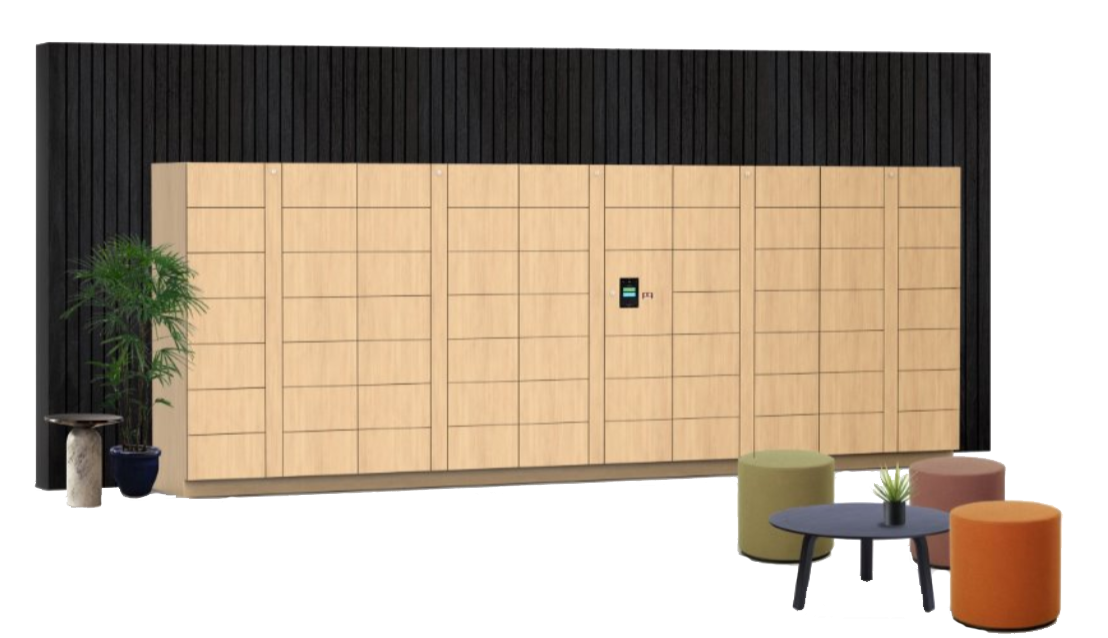
Smiota’s smart locker systems are designed for high-traffic, high-demand environments like gyms and fitness clubs. Here’s why operators choose us:
- Custom modular systems: From small studios to national chains, Smiota lockers scale to fit your space.
- Multiple access methods: App, tablet, biometric—your members have options.
- Easy integrations: Sync locker access with your existing gym management software.
- Built-to-last construction: Designed for daily, heavy usage without breaking down.
With Smiota, you’re not just installing lockers. You’re upgrading to a fully integrated, modern member experience.
The Business Case for Smart Locker Adoption
Adopting smart locker technology isn’t just a tech move—it’s a business strategy. Here’s what fitness centres gain:
- Higher member satisfaction: People love convenience, and smart lockers deliver it.
- Increased retention: Members who enjoy a seamless experience are more likely to stay.
- Reduced support tickets: Staff spends less time resolving locker issues and more time improving the facility.
- A modern brand image: A tech-forward approach resonates with today’s digitally fluent audience.
Whether you’re a boutique yoga studio, a corporate wellness center, or a franchise gym, smart lockers help you stand out—and scale up.
Conclusion: Redefining Locker Rooms for the 21st Century
The fitness industry is evolving—and fast. Members want more than dumbbells and ellipticals. They want efficiency, safety, and a tech-savvy environment that makes their lives easier.
Smart lockers meet those demands and then some. They enhance security, reduce staff workload, maximize space, and offer lifestyle perks that today’s fitness users truly value.
By choosing Smiota, fitness centers gain more than a locker system, they get a trusted partner offering customizable, durable, and cutting-edge smart locker solutions designed to grow with your facility. Smiota’s technology ensures your gym stays ahead of trends while elevating the member experience every day.
In a competitive landscape, small conveniences make a big difference. Smiota helps your facility lead the way.
The post How Smart Lockers Elevate Fitness Centers: Security, Efficiency, and Experience in One Solution appeared first on Smiota.
]]>The post Role of smart lockers in retail digital transformation appeared first on Smiota.
]]>This blog post will explore the evolution of digital transformation in retail, the major trends shaping the space for 2025, and the critical role smart lockers play in meeting modern consumer expectations.
Evolution of Digital Transformation in Retail
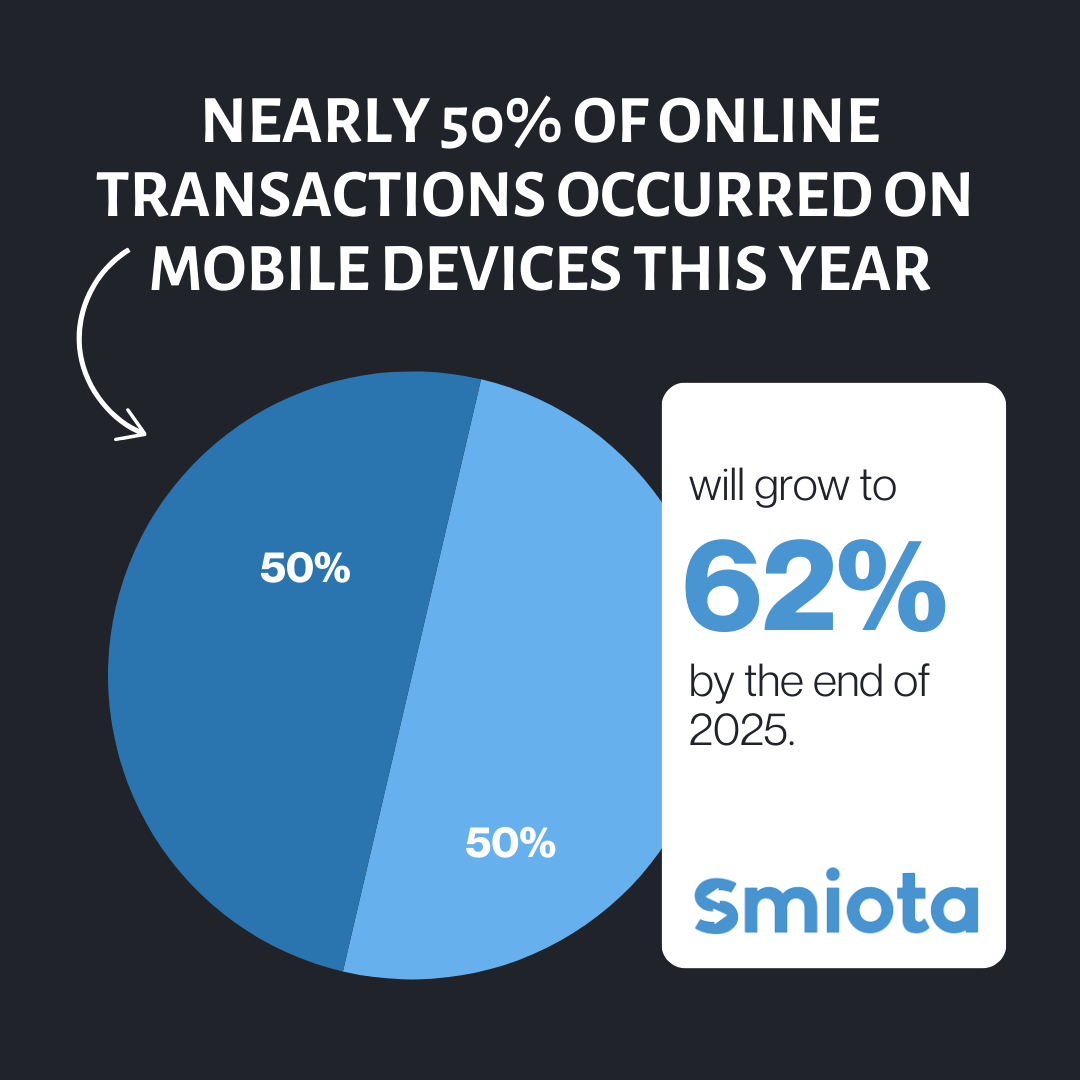
The retail industry has undergone a significant digital evolution over the past decade, transforming the way businesses connect with customers and manage operations.
The Journey So Far
Retail’s journey into the digital age has been marked by significant milestones. A decade ago, e-commerce redefined the shopping experience, making products accessible with a few clicks. Then, omnichannel strategies emerged, offering customers seamless experiences across in-store and online platforms. More recently, retailers have adopted artificial intelligence (AI) and data analytics to understand consumer preferences and deliver personalized experiences. These transformations were responses to changes in consumer behavior, where convenience, personalization, and technology-driven experiences became paramount.
Current Drivers of Change
Today’s retail landscape is driven by the need to adapt to modern consumer behaviors, address labor challenges, and leverage emerging technologies. With more customers demanding flexible options for retrieving purchases, retailers are focusing on digital convenience and operational efficiency. Smart lockers are one response to these drivers, offering a technology-forward solution that simplifies last-mile delivery and enhances customer satisfaction.
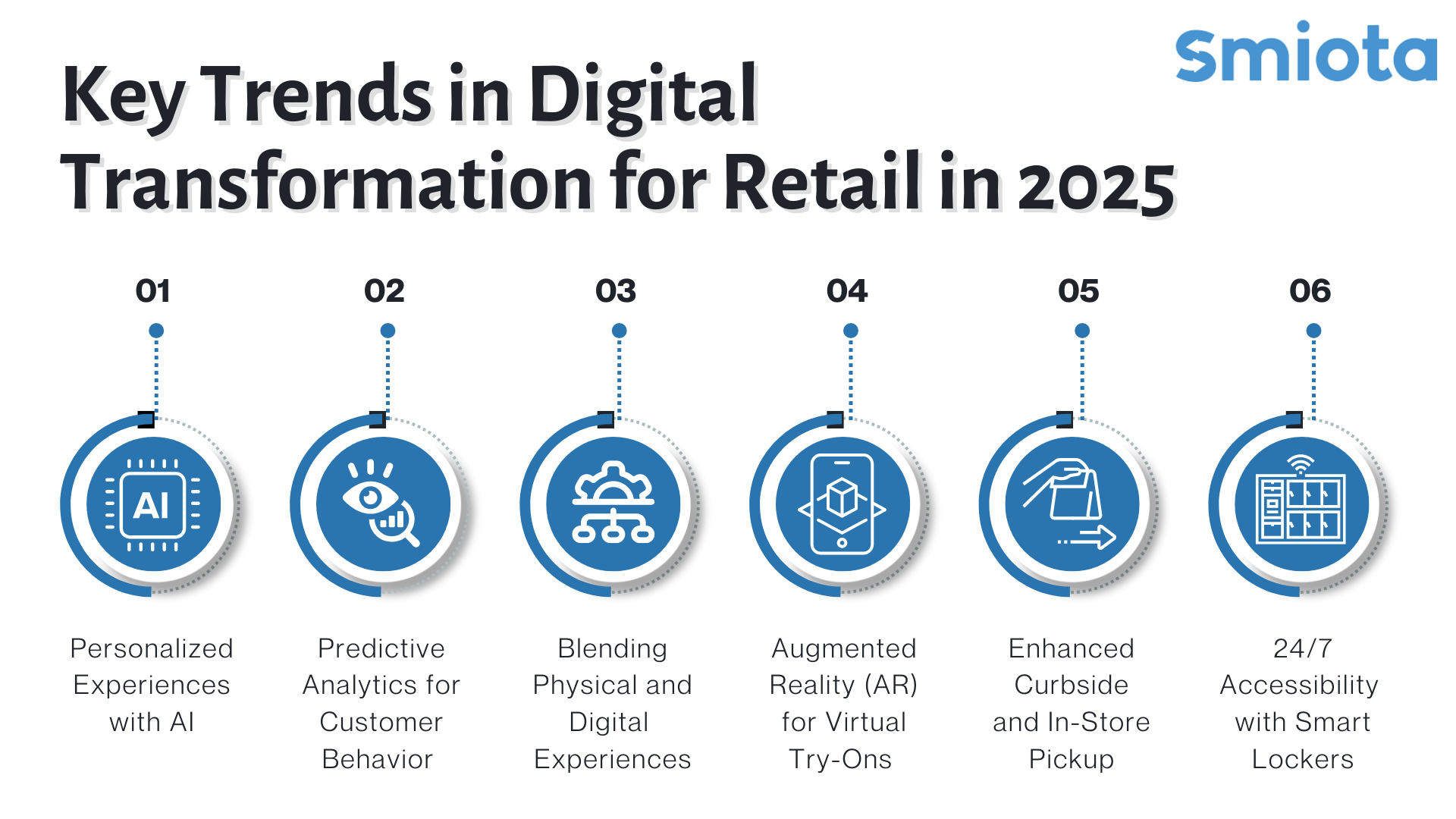 Key Trends in Digital Transformation for Retail in 2025
Looking ahead to 2025, digital transformation in retail continues to push boundaries, with new-age technologies at the forefront of customer engagement. Following are some of the key digital trends:
a) AI-Powered Personalization and Customer Insights
Personalized Experiences with AI
Advanced AI algorithms allow retailers to create highly personalized customer journeys. From tailored product recommendations to targeted marketing, AI enables brands to engage consumers in a meaningful, individualized way. Personalization has moved beyond simple recommendations; it now involves using data to deliver unique, context-based experiences.
Predictive Analytics for Customer Behavior
AI-driven predictive analytics helps retailers anticipate purchasing patterns, allowing for better inventory management and more accurate marketing strategies. By analyzing customer data, retailers can predict when specific products will be in demand, avoiding stockouts and better meeting customer needs.
b) Phygital Experiences
Blending Physical and Digital
The “phygital” trend, blending physical and digital experiences, has become essential to providing consumers with seamless shopping options. For example, consumers may browse products online but pick them up in-store through smart lockers. This integration enhances convenience and aligns with the demand for immediate, flexible shopping experiences.
Augmented Reality (AR) for Virtual Try-Ons
Retailers are increasingly using AR to allow customers to try on products virtually, from clothes to makeup, in their homes. This not only enhances the shopping experience but also helps customers make better-informed purchase decisions without visiting a store.
c) Smart Locker and Curbside Pickup Innovations
Enhanced Curbside and In-Store Pickup
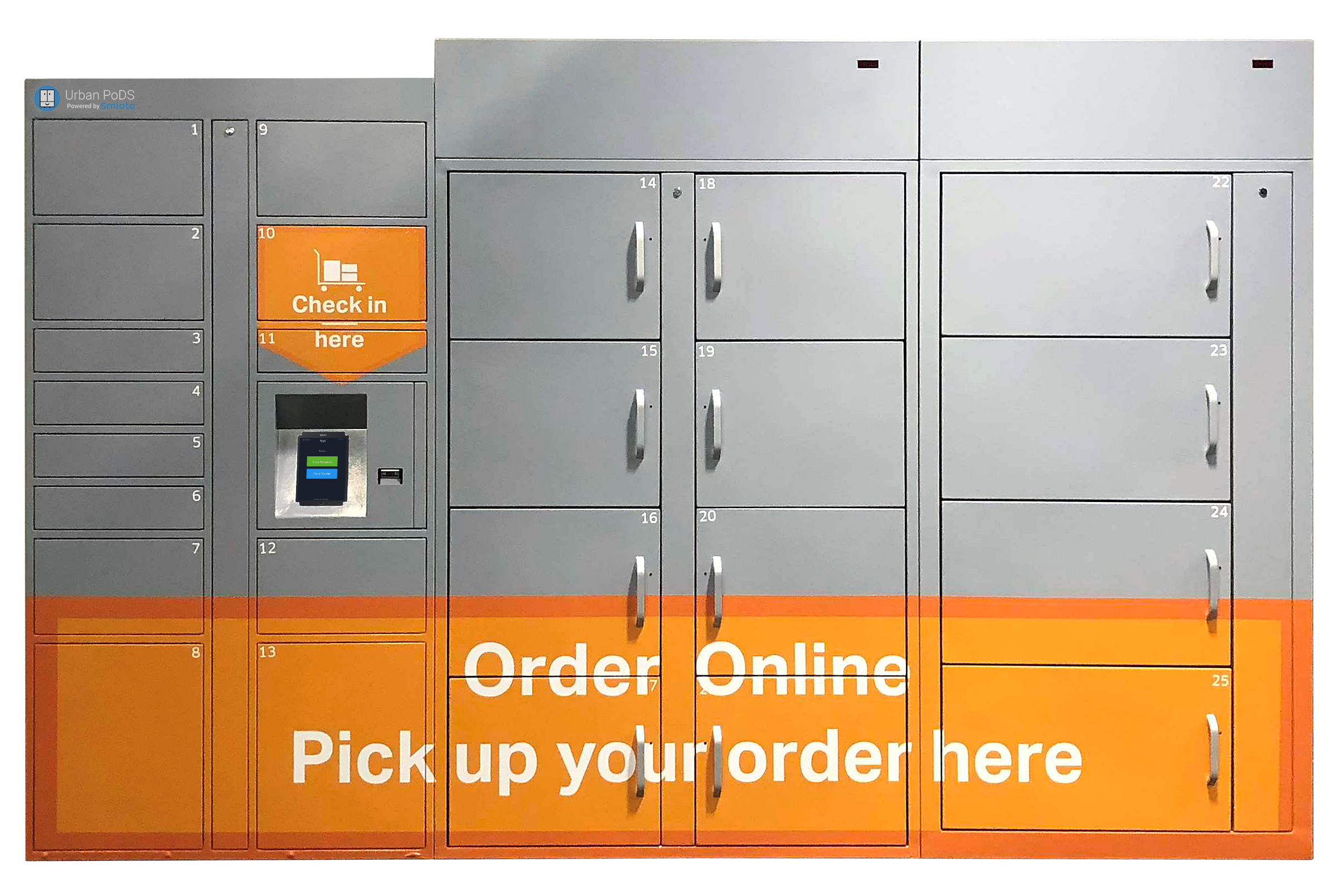
Smart lockers have transformed curbside pickup by offering customers convenient and secure locations to collect their purchases. These lockers reduce wait times, allow customers to skip long lines, and simplify the pickup process. Whether in-store or curbside, smart lockers cater to consumers looking for quick, contactless service.
24/7 Accessibility
A significant advantage of smart lockers is that they are accessible 24/7, which appeals to busy consumers who may not be able to visit stores during regular hours. This accessibility aligns with the on-demand culture digital transformation aims to support, improving customer satisfaction by enhancing convenience.
Emerging Technologies Transforming Retail in 2025
a) Internet of Things (IoT) for Inventory and Supply Chain Management
Real-Time Inventory Tracking
IoT sensors are causing a tectonic shift in inventory management by providing real-time tracking. With these sensors, retailers can monitor stock levels, reducing the risk of out-of-stock situations. Accurate inventory tracking also helps streamline supply chains and ensures customers get what they need when they need it.
Smart Shelves and Automated Replenishment
IoT-powered smart shelves detect product levels and can trigger automatic replenishment orders. This technology reduces manual labor, keeps shelves stocked, and improves the shopping experience by ensuring products are always available.
b) Blockchain for Transparency and Traceability
Supply Chain Transparency
Blockchain technology enables greater transparency in the retail supply chain. Customers can access detailed product information, such as origin and ethical sourcing practices, directly from blockchain data. This transparency builds trust and resonates with socially conscious consumers.
Combatting Counterfeit Goods
Blockchain also combats counterfeits by verifying product authenticity. This is crucial for luxury brands and high-end products, where counterfeiting is a significant concern. Authenticity verification through blockchain gives customers confidence in the products they purchase.
c) Robotics and Automation in Physical Stores
Automated Checkout Systems
Automation in retail extends to checkout systems, with cashier-less checkouts and self-service kiosks becoming more prevalent. These systems streamline the purchasing process, reduce wait times, and offer a smooth, tech-enabled shopping experience.
Robots for Inventory Management
Robots are increasingly used for tasks like restocking shelves and counting inventory. They improve accuracy and reduce human errors, making retail operations more efficient and enabling staff to focus on customer service.
How Digital Transformation Contributes to Creating an Omnichannel Experience
An enhanced omnichannel experience allows shoppers to interact with brands on their terms, whether they’re browsing in-store or purchasing online. Digital transformation makes this possible through the following elements.
a) Unified Customer Profiles and Data Integration
Connecting Online and Offline Data
Retailers are now able to create unified customer profiles by integrating data from online and offline interactions. This data integration allows for a consistent shopping experience, whether the customer is on a mobile app, website, or in the store. Unified data also enables retailers to tailor their marketing strategies and engage with customers more effectively.
Personalized Omnichannel Marketing
With integrated data, retailers can launch personalized campaigns across multiple channels, delivering a cohesive message. This approach helps keep brands top-of-mind, improves customer retention, and fosters brand loyalty.
b) Advanced Mobile Shopping Features
Mobile Payment Innovations
Mobile payment options, including biometric and contactless payments, are gaining popularity. They provide quick, secure transaction methods, enhancing the in-store experience by minimizing checkout times and giving customers a high-tech, hassle-free process.
In-App Experiences and Gamification
Retailers use apps to engage customers through gamification, loyalty programs, and personalized shopping experiences. These apps offer users exclusive deals, reward programs, and interactive experiences that keep them returning and increase brand loyalty.
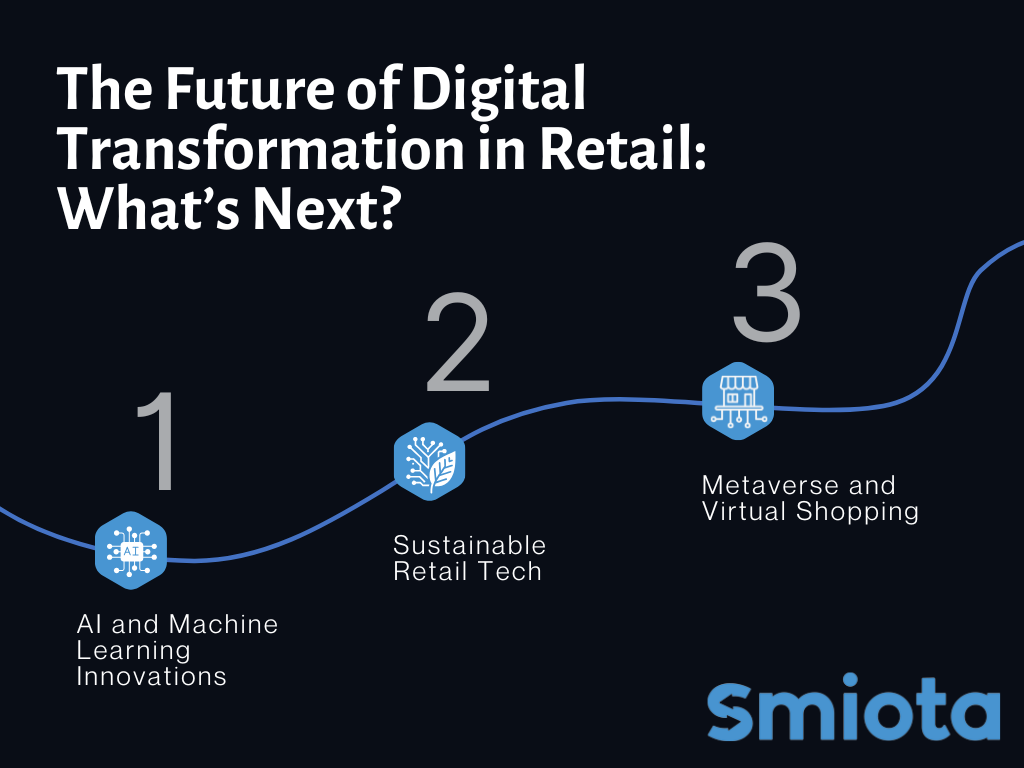
The Future of Digital Transformation in Retail
As digital technologies improve, the future of retail promises even more immersive, data-driven, and customer-centric experiences. Emerging technologies will reshape how retailers connect with and serve their customers, setting new standards for innovation in the industry.
AI and Machine Learning Innovations
Future advancements in AI and machine learning will continue to shape retail, enabling even greater personalization and automation. These technologies will provide real-time customer insights, further streamlining operations and driving customer engagement.
Sustainable Retail Tech
Sustainability is a rising priority for consumers and businesses alike. Retailers are likely to adopt eco-friendly solutions, such as energy-efficient IoT devices and recycling initiatives. These efforts not only appeal to environmentally conscious consumers but also help retailers reduce operational costs.
Metaverse and Virtual Shopping
The metaverse is expected to reshape digital retail experiences, offering virtual stores where customers can browse and shop in an immersive, interactive environment. This technology could allow consumers to interact with products in a virtual space, bringing a new dimension to online shopping.
Conclusion
The retail industry is starting to adopt modern technologies more and more. From AI-driven personalization to IoT for supply chain efficiency, each innovation brings retailers closer to meeting modern consumer expectations. Among these technologies, smart lockers have emerged as a critical tool, offering convenience, security, and flexibility to customers’ demand.
Solutions like Smiota smart lockers enhance the omnichannel experience by streamlining order pickups, reducing wait times, and providing secure 24/7 access to purchases. As retailers continue their digital transformation journey, adopting smart locker solutions like Smiota can be a game-changer—enabling businesses to meet customer expectations seamlessly, reduce operational friction, and stay competitive in an increasingly digital marketplace.
The post Role of smart lockers in retail digital transformation appeared first on Smiota.
]]>The post The Role of Smart BOPIS Lockers in Sustainable Retail appeared first on Smiota.
]]>These consumers not only want high-quality products but also expect the companies they buy from to demonstrate environmental responsibility. This new wave of socially conscious shoppers has created a significant opportunity for businesses to attract and retain customers by implementing sustainable retail practices.
As companies adopt these sustainable practices, one innovative solution stands out: Smart BOPIS (Buy Online, Pick Up In-Store) lockers. These lockers offer a convenient, eco-friendly alternative to traditional shopping methods, helping retailers reduce their carbon footprint while enhancing the customer experience.
In this blog post, we’ll explore the growing demand for sustainable retail, why investing in it is worthwhile, and how smart BOPIS lockers can be a key component of a retailer’s sustainability strategy.
Why Investing in Sustainable Retail Is Worth It
The demand for sustainability has grown significantly, as evidenced by numerous statistics and studies. According to a report from Nielsen, 73% of global consumers say they would or probably change their consumption habits to reduce their environmental impact. This is particularly true for younger generations, with 90% of Gen Z indicating they believe companies have a responsibility to address environmental and social issues. Furthermore, a Unilever study found that a third of consumers are now choosing to buy from brands based on their social and environmental impact.
Retailers have taken note of these trends, with many investing in sustainable retail practices. They are also focusing on reducing packaging waste, sourcing sustainable materials, and adopting cleaner energy sources. These initiatives not only reduce environmental harm but also align with consumer expectations, giving brands a competitive edge in the market.
Sustainable retail offers several benefits, both for businesses and the planet:
- Enhanced Brand Loyalty: Consumers are more likely to support brands that share their values. Sustainable practices can help build trust and loyalty.
- Cost Savings: Reducing energy consumption, waste, and transportation costs can lower operational expenses.
- Regulatory Compliance: Governments are increasingly imposing regulations around sustainability, and adopting these practices early helps retailers stay ahead of the curve.
- Positive Impact on the Planet: Sustainable retail reduces resource consumption, lowers greenhouse gas emissions, and minimizes pollution, contributing to a healthier environment.
Sustainable Retail Strategies
To create a meaningful impact, retailers must adopt various sustainability strategies. Below are some key tactics that can help reduce the environmental footprint of a retail operation:
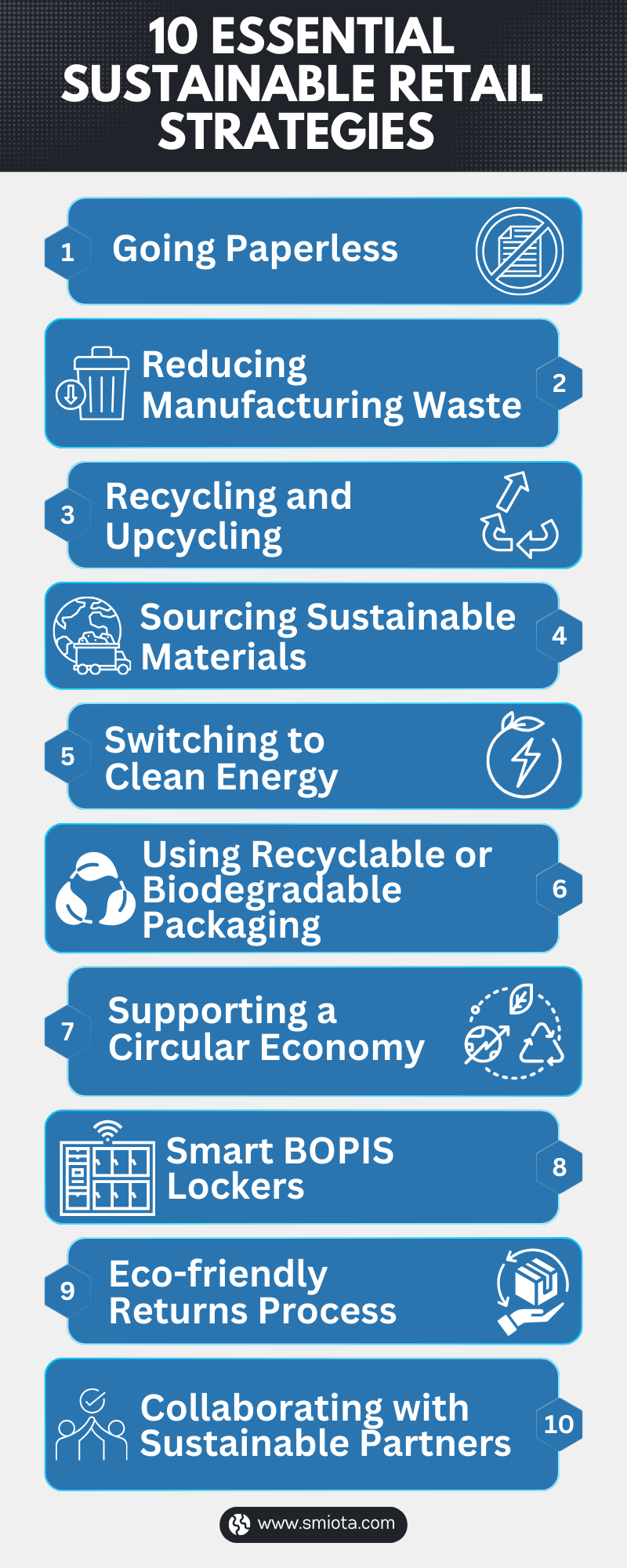
- Going Paperless: Implementing digital solutions for receipts, billing, and marketing materials can significantly reduce paper waste. Many retailers are adopting e-receipts, which are not only more convenient for customers but also eco-friendly.
- Reducing Manufacturing Waste: Retailers can focus on optimizing production processes to minimize waste. This could involve using lean manufacturing techniques or re-engineering products to be more resource efficient.
- Recycling and Upcycling: Offering recycling programs for used products and packaging is an excellent way to reduce waste. Upcycling involves repurposing returned goods, unsold inventory, or defective products, giving them a second life.
- Sourcing Sustainable Materials: Retailers should prioritize using materials that are ethically sourced, biodegradable, or recyclable. For example, many clothing brands now use organic cotton or recycled polyester in their products.
- Switching to Clean Energy: Investing in renewable energy sources such as solar or wind power can help reduce carbon emissions and reliance on fossil fuels.
- Using Recyclable or Biodegradable Packaging: Packaging is a significant contributor to waste, but switching to eco-friendly alternatives, such as recyclable or biodegradable materials, can help address this issue.
- Supporting a Circular Economy: Adopting a circular business model where products are designed to be reused, repaired, or recycled helps reduce waste and promotes sustainability.
- Smart BOPIS Lockers: Smart lockers offer an innovative solution for retailers looking to reduce their carbon footprint. These lockers allow customers to pick up their online purchases at a physical location, reducing the need for home deliveries.
- Eco-friendly Returns Process: Implementing a seamless returns process that utilizes smart lockers can reduce the environmental impact associated with transporting returned goods back to warehouses.
- Collaborating with Sustainable Partners: Retailers should seek out suppliers and business partners that share their commitment to sustainability, ensuring that their entire supply chain aligns with eco-friendly values.
Smart BOPIS Lockers: A Key to Sustainable Retail
One of the most effective strategies for sustainable retail is adopting smart BOPIS lockers. These lockers, like those offered by Smiota, are designed to streamline the order pickup process while reducing the environmental impact of traditional delivery methods. Here’s how smart BOPIS lockers contribute to sustainability:
- Smart Software Integration: Smart lockers integrate with cloud-based mailroom apps like SC Logic and Smiota, enabling real-time delivery notifications and paperless tracking. This digital automation reduces unnecessary streamlines the pickup process, cutting down on energy waste and improving operational efficiency.
- Reducing Carbon Emissions: By offering a centralized pickup location, smart lockers reduce the need for delivery vehicles to make multiple stops at individual homes. This reduction in transportation results in fewer carbon emissions and less traffic congestion.
- Resource Efficiency through an Open Locker Network: An open smart locker network, maintained by a provider like Smiota, allows multiple retailers to share the same locker infrastructure. This means that businesses can reduce the need for installing separate locker systems at each store, optimizing the use of resources. Retailers can join the network and use available lockers based on need, further reducing operational costs and environmental impact.
- Minimizing Packaging Waste: When customers use BOPIS lockers, they often have the option to pick up their items without excessive packaging, which is common in home This reduces the amount of packaging waste generated.
- Fewer Delivery Trips: Smart lockers enable customers to consolidate their purchases and pick them up at their convenience, reducing the number of delivery trips needed. This not only lowers emissions but also cuts down on fuel consumption.
- Streamlined Returns: The open locker network also facilitates a more efficient returns process. Instead of shipping returns to a central warehouse, customers can drop off their returns at a smart locker. This eliminates the need for additional transportation and reduces the carbon footprint associated with returns.
- Improved Convenience and Sustainability: Smart lockers enhance the shopping experience by offering convenience and flexibility. Customers can collect their items at a time that suits them, which helps reduce delivery-related delays and missed deliveries that contribute to environmental waste.
- Energy Efficiency: Modern smart lockers are designed with energy efficiency in mind. Many systems use energy-saving features and are made from sustainable materials, further reducing their environmental impact.
Conclusion
Sustainability is no longer a choice for retailers but a necessity. As consumers increasingly demand eco-friendly products and services, businesses that invest in sustainable practices will thrive in the long term. Among the many strategies available, smart BOPIS lockers provide a unique opportunity to reduce carbon emissions, optimize resource use, and enhance the customer experience.
Smiota’s smart lockers are not only designed to improve operational efficiency but also contribute to a greener retail ecosystem. By integrating smart lockers into your retail strategy, you can meet the needs of today’s socially conscious customers while making a positive impact on the environment. Let Smiota help your business embrace sustainable retail solutions and join the growing movement towards an eco-friendlier future.
The post The Role of Smart BOPIS Lockers in Sustainable Retail appeared first on Smiota.
]]>The post Smart Lockers: The Preferred Choice of Delivery for Online Shoppers appeared first on Smiota.
]]>This blog post discusses the reasons why smart lockers are becoming the go-to option for online shoppers. We will explore the convenience and flexibility they offer, their enhanced security features, and the streamlined delivery process they enable. Additionally, we will discuss how retailers and e-commerce platforms are adopting smart lockers to improve their operations and cater to the evolving needs of customers.
The Rise of Online Shopping and Its Challenges
The COVID-19 pandemic accelerated the adoption of online shopping, as consumers sought convenient and safe ways to purchase goods. This surge in e-commerce has put immense pressure on delivery networks, leading to increased demand for efficient and reliable delivery solutions.
Last-mile delivery, the final leg of the delivery journey, has been particularly challenging. Missed deliveries due to recipient absence, package theft, and delivery delays have frustrated consumers and impacted the overall satisfaction with online shopping.
What Are Smart Lockers?
Smart lockers are automated storage units that offer a secure and convenient way for individuals to receive and retrieve packages. These lockers are typically equipped with advanced technology, such as PIN codes, QR codes, or mobile app access, allowing users to easily open and access their designated compartments.
Types of Smart Lockers
Smart lockers can be found in various locations, including:
- Retail Stores: Retailers often install smart lockers for Buy Online, Pick Up In-Store (BOPIS) options, providing customers with a convenient and contactless way to receive their purchases.
- Apartment Complexes: Many apartment complexes offer smart lockers for package delivery, eliminating the need for residents to be present during delivery hours.
- University Campuses: Universities often deploy smart lockers to facilitate package delivery for students, reducing the burden on campus mailrooms.
- Corporate Offices: Businesses may install smart lockers for employee package delivery, improving efficiency and reducing the need for manual package handling.
- Public Spaces: Smart locker hubs are increasingly being installed in public areas, such as shopping malls, transportation hubs, and community centers, to provide convenient package pickup options for residents and commuters.
Why Smart Lockers Are the Preferred Option for Online Shoppers
Smart lockers offer many benefits for online shoppers, making them a preferred choice for package delivery.
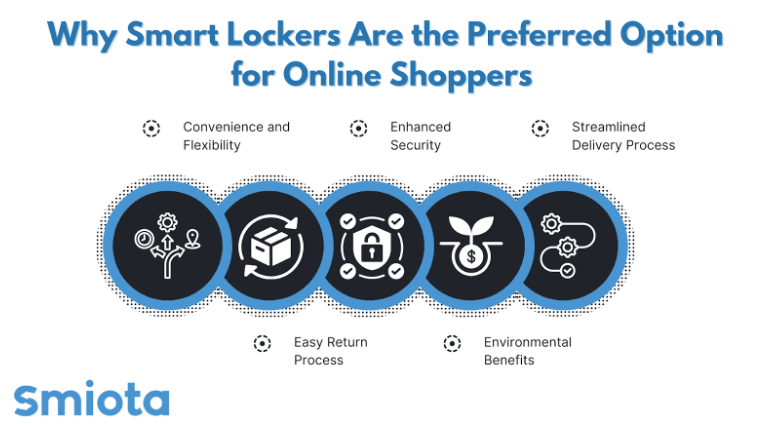
Convenience and Flexibility
- 24/7 Access: Smart lockers provide the flexibility to retrieve packages at any time, eliminating the need to schedule deliveries or be present during specific hours. This is particularly beneficial for busy individuals or those with unpredictable schedules.
- Multiple Pickup Locations: The widespread availability of smart lockers in various locations, including retail stores, apartment complexes, universities, and public spaces, offers shoppers the convenience of choosing the most accessible pickup point. This flexibility allows shoppers to incorporate package retrieval into their daily routines without significant detours.
Enhanced Security
- Secure Package Storage: Smart lockers provide a secure environment for storing packages, protecting them from theft, loss, or damage. The controlled access and surveillance features of smart lockers significantly reduce the risk of unauthorized access.
- Reduced Risk of Theft: By eliminating the need for doorstep delivery, smart lockers mitigate the risk of package theft, commonly known as “porch piracy.” This provides peace of mind for shoppers who may have experienced previous losses due to package theft.
Streamlined Delivery Process
- Automated Notifications: Shoppers receive instant notifications when their packages arrive in the smart locker, eliminating the need to track delivery status or wait for notifications from delivery carriers.
- Quick and Easy Retrieval: Retrieving packages from smart lockers is a simple process. Users can typically access their packages using PIN codes, QR codes, or mobile app authentication, without the need for lengthy procedures or interactions with delivery personnel.
Easy Return Process
- Simplified Returns: Smart lockers can be used for two-way package transfer, allowing shoppers to easily return items to retailers. This streamlined return process enhances the overall shopping experience and reduces the hassle associated with returns.
- Reduced Return Logistics: By utilizing smart lockers for returns, retailers can streamline their logistics operations and reduce the costs associated with reverse logistics.
Environmental Benefits
- Reduced Delivery Attempts: Smart lockers can significantly reduce the number of failed delivery attempts due to recipient absence, leading to lower carbon emissions and improved delivery efficiency.
- Efficient Consolidation: By consolidating multiple packages for a single recipient in smart lockers, delivery carriers can optimize their routes and reduce the environmental impact of last-mile logistics.
How Retailers and E-commerce Platforms Are Adopting Smart Lockers
Retailers and e-commerce platforms are increasingly recognizing the value of smart lockers in enhancing the customer experience and improving operational efficiency.
In-Store Pickup Solutions
- BOPIS (Buy Online, Pick Up In-Store): Smart lockers have become a popular choice for retailers implementing Buy Online, Pick Up In-Store (BOPIS) strategies. By offering customers the option to pick up their online orders at a physical store location, retailers can provide greater convenience and flexibility. Smart lockers streamline the pickup process, eliminating the need for customers to wait in line and reducing the burden on store staff.
Strategic Partnerships
- Carrier and Retailer Collaborations: Logistics carriers and retailers are forming strategic partnerships to expand the availability of smart lockers. By installing lockers in convenient locations, such as shopping malls, transportation hubs, and residential areas, these partnerships ensure wider accessibility for customers.
- Marketplace Integration: E-commerce platforms are integrating smart locker options into their checkout processes, making it easier for customers to select this delivery method. This integration provides a seamless experience for shoppers and helps drive adoption of smart locker technology.
Future Trends in Smart Lockers for E-commerce
As technology continues to advance, we can expect to see further innovations in smart locker technology and their integration into the e-commerce landscape.
Technological Advancements
- AI and Machine Learning: AI and machine learning algorithms can be used to optimize locker placement, predict customer preferences, and improve overall system efficiency. For example, AI can analyze customer data to identify high-traffic areas and optimize locker distribution accordingly.
- IoT Integration: Smart lockers can be integrated with other IoT devices, such as smart home systems or delivery robots, to create a more connected and seamless experience. This integration can enable features like automated package notifications, real-time tracking, and personalized recommendations.
Increased Customization
- Personalized Locker Experiences: Future smart lockers may offer personalized experiences based on user preferences and behavior. For example, lockers could recommend products based on previous purchases or offer tailored notifications.
- Expansion of Locker Types: Specialized lockers, such as refrigerated lockers for grocery deliveries or temperature-controlled lockers for sensitive items, may become more common as e-commerce expands into new product categories.
Sustainability Initiatives
- Eco-Friendly Designs: Smart locker manufacturers are increasingly focusing on sustainable materials and energy-efficient technologies to reduce their environmental impact.
- Green Logistics: Smart lockers can play a role in broader green logistics strategies aimed at minimizing the carbon footprint of e-commerce. By reducing delivery attempts and consolidating packages, smart lockers can contribute to a more sustainable supply chain.
Conclusion
Smart lockers have emerged as a game-changer in the e-commerce landscape, offering a comprehensive solution to the challenges associated with package delivery. By providing unparalleled convenience, security, and efficiency, smart lockers revolutionize the way online shopping is experienced.
For online shoppers, smart lockers offer the flexibility to retrieve packages at their convenience, eliminating the need to schedule deliveries or be present during specific hours. The secure storage provided by smart lockers ensures peace of mind and reduces the risk of package theft. Moreover, the delivery process and automated notifications enhance the overall shopping experience.
Retailers and e-commerce platforms can also benefit significantly from implementing smart lockers. By optimizing operations, reducing costs, and improving customer satisfaction, smart lockers enable businesses to stay competitive in the fast-paced world of online retail.
Experience the future of package delivery with Smiota smart lockers. Our innovative solutions offer unparalleled convenience, security, and efficiency. Contact us today to learn more and discover how Smiota can elevate your business.
The post Smart Lockers: The Preferred Choice of Delivery for Online Shoppers appeared first on Smiota.
]]>The post Smart Technologies to give Interactive Shopping Experience to your Customers appeared first on Smiota.
]]>The rise of e-commerce has set new standards for customer experience; consumers now anticipate a seamless transition between online and offline shopping. They expect to shop from the comfort of their homes and enjoy immersive experiences when visiting brick-and-mortar stores. This shift has made it imperative for retailers to reinvent their approach by integrating smart technologies to improve customer engagement, turning shopping from a mere transaction into a comprehensive, enjoyable experience.
Role of Smart Technologies in Retail
Smart technologies are transforming retail through Artificial Intelligence (AI), Augmented Reality (AR), the Internet of Things (IoT), and big data analytics. These innovations offer personalized experiences that attract and retain customers in unique ways:
- Artificial Intelligence (AI): AI tailors the shopping experience through chatbots for instant customer service and recommendation engines that suggest products based on individual shopping histories and preferences.
- Augmented Reality (AR): AR changes how customers interact with products. For example, AR mirrors in clothing stores allow virtual outfit try-ons, and AR apps help visualize home furniture placements before purchases.
- Internet of Things (IoT): IoT connects retail elements to boost operational efficiency and customer service. Smart shelves with weight sensors monitor inventory in real time, while IoT devices adjust store conditions, such as lighting and temperature, to improve the shopping atmosphere.
- Big Data Analytics: Analyzing data from online and in-store interactions offers insights into consumer behavior. This analysis helps retailers fine-tune marketing strategies, improve product placements, and enhance shopping experiences.
As retailers continue to adopt these technologies, the shopping experience is becoming more interactive, not just in responding to consumer actions but also in anticipating their needs and preferences. This proactive approach to customer engagement is setting new standards in the industry, making the need for interactive shopping imperative.
The Need for Interactive Shopping
Smart technology transformation is primarily driven by consumers’ demands for more than just products; they seek engaging, informative, and entertaining shopping experiences. As the gap between digital and physical shopping experiences continues to narrow, there is a growing expectation for the convenience of digital features to merge with the sensory benefits of physical stores. To meet these expectations, retailers are increasingly adopting smart technologies to create dynamic environments that cater to customers’ needs and enrich their shopping experience, making it more efficient, personalized, and tactile.
Interactive shopping not only meets modern consumer expectations but also provides substantial benefits to both retailers and customers. By incorporating smart technologies to boost customer engagement, retailers can deliver a more impactful shopping experience, fostering repeat business and building loyalty. Additionally, the personalized approach of interactive shopping offers targeted recommendations, enhancing customer satisfaction and boosting sales.
Benefits of Interactive Shopping for Customers and Retailers
Incorporating AR in retail transforms how customers interact with products, enhancing satisfaction and reducing returns and exchanges, thus streamlining the shopping process.
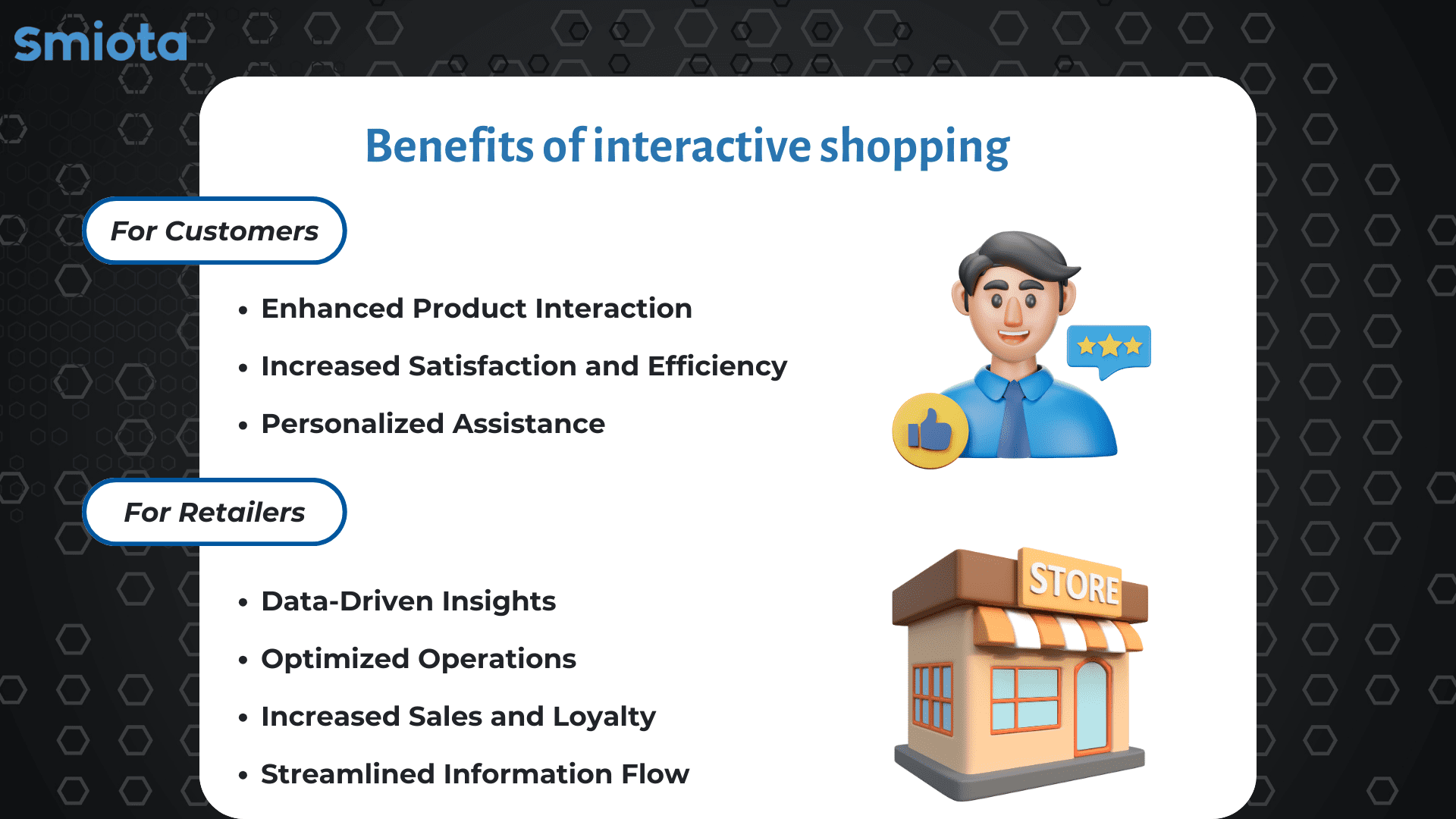
For Customers
- Enhanced Product Interaction: Augmented Reality (AR) enables customers to visualize how products, like furniture or makeup, would look in their environment or on their skin without needing physical trials.
- Increased Satisfaction and Efficiency: These interactive experiences boost satisfaction by ensuring products meet expectations before purchase, reducing the need for returns and exchanges.
- Personalized Assistance: AI and IoT integration in stores, such as smart dressing rooms, offer customized recommendations (like suggesting accessories) based on the items customers are trying on, simulating a personal shopping assistant experience.
For Retailers
- Data-Driven Insights: Retailers collect valuable data on customer preferences, behaviors, and purchasing patterns by utilizing smart technologies.
- Optimized Operations: This data allows retailers to effectively optimize stock levels, store layout, and marketing strategies.
- Increased Sales and Loyalty: Leveraging these insights helps tailor the shopping experience to meet customer expectations, increasing sales and enhancing customer loyalty.
- Streamlined Information Flow: Integration of AI and IoT ensures a seamless information flow throughout the customer journey, from entry to post-purchase, enhancing the overall shopping process.
Integrating smart technologies in retail meets the modern consumer’s demands for engaging, efficient, and personalized shopping experiences while enabling retailers to enhance their operations and strategies. We will demonstrate how the future of retail relies on using these innovations to transform transactions into memorable, brand-strengthening events.
Examples of Interactive Shopping Experiences
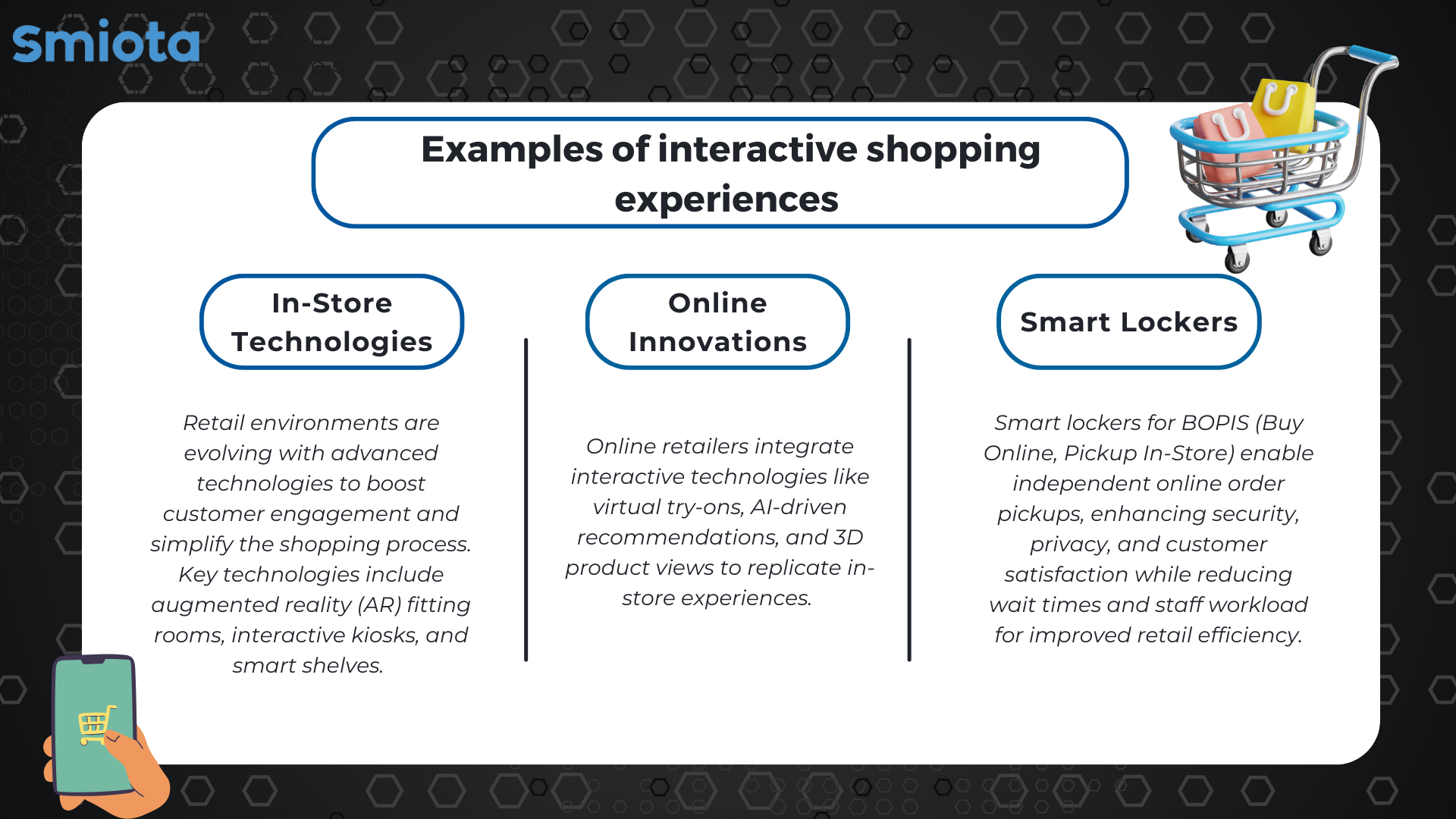
In-Store Technologies:
Retail environments are evolving with advanced technologies to boost customer engagement and simplify the shopping process. Key technologies include augmented reality (AR) fitting rooms, interactive kiosks, and smart shelves.
- AR fitting rooms allow customers to try on clothes virtually using a digital mirror. This eliminates the need for physically changing and saves time while improving the shopping experience.
- Interactive kiosks act as digital assistants, offering product details, recommendations, and comparisons with a simple touch. They streamline checkouts, enroll customers in loyalty programs, and tailor shopping experiences based on user data and shopping history.
- Smart shelves feature sensors and digital displays that provide real-time updates on pricing, product details, and promotions and monitor inventory levels to prompt restocking. They enhance product interaction with dynamic information and ads that adjust as customers browse.
Online Innovations:
Online retailers integrate interactive technologies like virtual try-ons, AI-driven recommendations, and 3D product views to replicate in-store experiences.
- Virtual try-ons enable customers to preview how items, particularly cosmetics and eyewear, will look on them via their device’s camera. This reduces online shopping risks, decreases returns, and builds purchase confidence.
- AI algorithms personalize online shopping by suggesting products based on customers’ browsing patterns and past purchases, enhancing user experience and encouraging sales.
- Immersive 3D views allow customers to examine products from all angles. This interactive feature lets users zoom and rotate 3D models, offering a realistic sense of the product and aiding in more informed buying decisions.
Smart Lockers:
Smart lockers streamline the online-to-store shopping transition, which is vital for the BOPIS (Buy Online, Pickup In-Store) strategy. They enable customers to order online and conveniently pick up their items without staff involvement, ensuring item security and privacy. These lockers facilitate personalized shopping experiences, minimize wait times, and allow staff to focus on other tasks, increasing overall customer satisfaction and operational efficiency in modern retail.
Smiota’s Smart Lockers: Enhancing Interactive and Personalized Shopping
Smiota’s smart lockers provide an advanced, secure solution for package management in multiple settings, including retail. These lockers automate delivery and pickup, enhancing efficiency and minimizing risks like human error or theft.
Key Features of Smiota’s Smart Lockers
- 24/7 Availability: The lockers are accessible anytime, day or night.
- Customizable Designs: Designs can be tailored to match the aesthetics of any business environment.
- Advanced Technology: Integration with cutting-edge technology enhances functionality.
- User-Friendly Interface: Lockers feature an easy-to-use interface.
- Mobile App Operation: Operable via a mobile app, compatible with iOS and Android devices, ensuring wide accessibility.
- Versatility: Adaptable for multiple uses beyond package delivery, such as dry cleaning drop-offs and IT asset management.
Integration of Smart Locker Solutions in Retail
Here’s how smart lockers can be effectively integrated into the retail environment to enhance customer interaction and satisfaction:
- Contactless BOPIS (Buy Online, Pickup In-Store): Smart lockers provide a contactless pickup option for online purchases, streamlining shopping and enhancing customer satisfaction.
- Integration with Retail Management Systems: They can integrate seamlessly with existing retail management systems, supporting real-time order tracking and customer notifications and ensuring efficient operations.
- Temperature Control Options: These temperature-controlled compartments are perfect for storing perishable goods in grocery stores and pharmacies without compromising product quality.
- Customization for Branding: Retailers can customize lockers with their brand’s colors, wraps, and logos, maintaining consistent branding and enhancing the visual appeal of the installation site.
- Operational Efficiencies: Smart lockers reduce the need for manual order handling, thereby decreasing staff workload, improving resource management, speeding up service, and boosting customer satisfaction.
- Analytics for Business Insights: The deployment of smart lockers also offers valuable data on customer behaviors and locker utilization, aiding retailers in making informed decisions to enhance service delivery.
Conclusion
Integrating smart technologies in retail is a strategic imperative for businesses aiming to thrive in a competitive market. These technologies offer a highly interactive and personalized shopping experience that meets the needs of today’s tech-savvy consumers, enhancing customer engagement and driving operational efficiencies, contributing to sustained business growth. The future of retail hinges on creating seamless, immersive, and responsive environments that captivate customers and foster brand loyalty. Therefore, embracing these smart technologies is not just about staying relevant—it’s about redefining the retail experience, making every customer interaction count, and transforming the ordinary act of shopping into a dynamic, engaging, and satisfying journey.
The post Smart Technologies to give Interactive Shopping Experience to your Customers appeared first on Smiota.
]]>The post Smart Retail Inventory Management with Smiota’s Retail Lockers and App appeared first on Smiota.
]]>However, as the retail landscape evolves with the digital age, traditional inventory management methods are becoming increasingly inadequate. This is where Smiota steps in, offering innovative retail lockers and a sophisticated app designed to meet the modern retailer’s needs for precision, agility, and efficiency in inventory management. By integrating real-time data, predictive analytics, and automated processes, Smiota’s solutions are indispensable for retailers who aim to stay competitive and maximize profitability.
Steps Involved in Retail Inventory Management
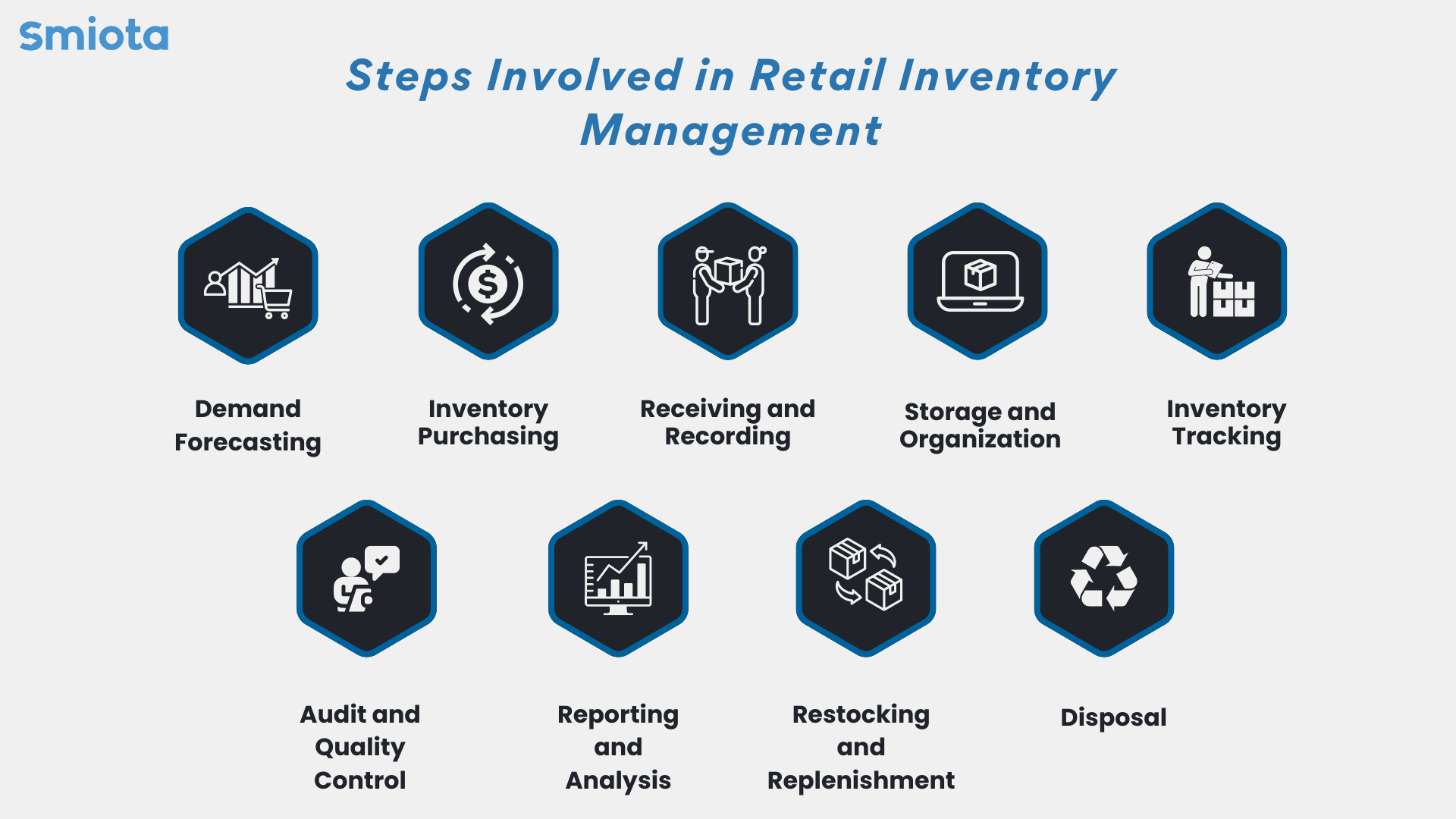
- Demand Forecasting: Predict future sales using historical data and market trends to maintain optimal stock levels.
- Inventory Purchasing: Manage supplier negotiations and purchase orders based on forecasted demand.
- Receiving and Recording: Accurately update inventory systems upon receiving new stock.
- Storage and Organization: Efficiently store goods to balance accessibility and space utilization.
- Inventory Tracking: Use tools like barcodes and RFID tags to monitor inventory levels and movements.
- Audit and Quality Control: Regularly check inventory accuracy and stock quality.
- Reporting and Analysis: Analyze inventory data to identify trends and inefficiencies.
- Restocking and Replenishment: Ensure a smooth flow of goods based on inventory analysis.
- Disposal: Remove excess or obsolete inventory in an eco-friendly manner.
When managed effectively, these steps form a cycle that can greatly enhance retail operational efficiency and customer satisfaction.
The Importance of Advanced Inventory Techniques in Retail
Retailers face numerous challenges such as overstocking, understocking, and logistics inefficiencies, which can significantly impact customer satisfaction and business profitability.
Smiota’s retail lockers and app present advanced solutions that improve inventory accuracy and logistics efficiency, ensuring customer satisfaction with reliable service. By adopting these technologies, retailers can enhance growth and profitability, turning challenges into strategic advantages.
Smart Techniques for Inventory Management
Building on the importance of advanced inventory techniques in retail, let’s explore some innovative ones that can enhance efficiency and accuracy in inventory management. These methods streamline operations and ensure that businesses can meet their customers’ needs effectively.
- Automated Replenishment Systems: These systems automatically track inventory levels and initiate orders when stocks fall below predefined thresholds, minimizing the risks associated with overstocking and understocking.
- Real-Time Inventory Tracking: Technologies like RFID tags and IoT sensors allow for the immediate identification of discrepancies, theft, and misplacements, ensuring accurate and up-to-date stock levels.
- Data Analytics and Forecasting: Big data analytics predict future inventory needs based on historical sales data, trends, and seasonal fluctuations, allowing retailers to manage their inventory proactively.
- Dynamic Pricing Strategies: Software tools adjust prices in real-time based on inventory levels, demand, and other market conditions to manage promotions and efficiently clear out excess stock.
- Mobile and Cloud-Based Inventory Management: These solutions allow seamless management across multiple locations, enhancing collaboration and decision-making.
- Integration of Smart Lockers: Systems like Smiota’s retail lockers facilitate secure, 24/7 pickup and return of products, reducing in-store congestion and improving inventory handling efficiency.
Smiota’s retail lockers revolutionize the Buy Online, Pick Up In-Store (BOPIS) model by automating the delivery, distribution, and notification processes. Their technology ensures secure, efficient package handling and supports real-time tracking and analytics, enhancing mailroom operations and inventory management.
Features and Benefits of Smiota’s smart Lockers in Inventory Management
Smiota’s smart lockers offer the following benefits to retailers:
- Security: Constructed from heavy-gauge steel with advanced security systems, ensuring secure storage until retrieval by the rightful owner.
- Space Optimization: Manage package storage and pickups efficiently, freeing up retail space.
- Operational Efficiency: Reduce staff involvement in package handling, leading to faster order fulfillment and improved productivity.
- Customer Experience: Provide 24/7 pickup capabilities, significantly enhancing customer satisfaction and loyalty.
- Analytics and Reporting: Offer real-time reporting capabilities for better inventory management decisions.
- Diverse Locker Features: Include temperature-controlled and customizable lockers for various product types and retail applications.
- Simplified Logistics and Staff Efficiency: Automates delivery and pickup processes, reducing staff burden and managing peak times effectively without extra staffing.
- Real-Time Monitoring: Features controlled access, real-time monitoring, and detailed analytics for security and operational optimization.
These smart lockers are fully customizable, allowing integration into any retail environment while maintaining brand consistency. Additionally, by incorporating Smiota’s smart lockers, in combination with the Smiota Service app, retail businesses can ensure an improved overall shopping experience.
Features and Uses of the Smiota Service App
The features listed below collectively aim to elevate the efficiency of retail inventory management, making processes more streamlined and data-driven.
- Task Management and Room Creation: The app supports creating designated rooms for different inventory categories and allows for assigning and managing tasks to streamline the workflow in retail environments.
- Real-Time Inventory Counts: Smiota’s platform offers real-time tracking of inventory levels. This ensures that retail operations maintain accurate stock counts, eliminating the risk of overstocking or stockouts.
- Report Generation: The app provides comprehensive reporting tools that help retailers analyze performance, track inventory status, and monitor other critical metrics. This functionality is crucial for maintaining records and making informed decisions.
- Predictive Analysis and Forecasting: Leveraging data collected through the app, retailers can perform predictive analyses to forecast future demand patterns. This helps optimize stock levels and effectively plan for future sales.
- Integration with Smart Lockers: Smiota’s Service seamlessly integrates with their smart locker systems, enhancing the Buy Online, Pickup In-Store (BOPIS) process. This integration helps in managing order fulfillment more efficiently, providing a contactless and convenient pickup option for customers.
Smiota’s Retail Lockers and Service app provide an integrated solution that enhances retail operations through improved inventory management, increased security, and enhanced customer satisfaction. By leveraging these tools, retailers can achieve a more efficient, secure, and customer-friendly shopping experience.
Use Cases of Smart Lockers in Retail Inventory Management
Enhanced BOPIS and Click-and-Collect
A Sports Apparel retailer implemented smart lockers across various stores in the US. Customers can order online and choose locker pickup at checkout. Upon order arrival, the customer receives a notification with a unique code to access their designated locker. This provides a convenient, contactless pickup option, especially outside regular store hours, increasing customer satisfaction and loyalty.
Secure Storage and Inventory Control
A Jewelry Retailer utilizes smart lockers in their stores to house expensive diamond and gemstone pieces. The lockers offer secure access control, deterring theft and shrinkage. Additionally, the retailer leverages the lockers for click-and-collect orders. Real-time tracking through the locker management app allows them to monitor stock levels and optimize inventory allocation between the showroom floor and secure lockers.
Conclusion
Smiota’s retail lockers and Service app represent a transformative leap in retail inventory management, addressing traditional challenges with innovative, technology-driven solutions. By integrating these systems, retailers can significantly streamline their operations, from automating stock replenishments to providing a seamless, contactless customer pickup experience. This not only boosts operational efficiency but also enhances customer satisfaction, making it a critical investment for retail businesses aiming to thrive in a competitive market. As retail continues to evolve, adopting such smart technologies will be vital in staying ahead, ensuring retailers can meet customer expectations with agility and precision. Embracing Smiota’s solutions is more than an upgrade—it’s a brilliant strategy for a more dynamic and resilient retail future.
The post Smart Retail Inventory Management with Smiota’s Retail Lockers and App appeared first on Smiota.
]]>